
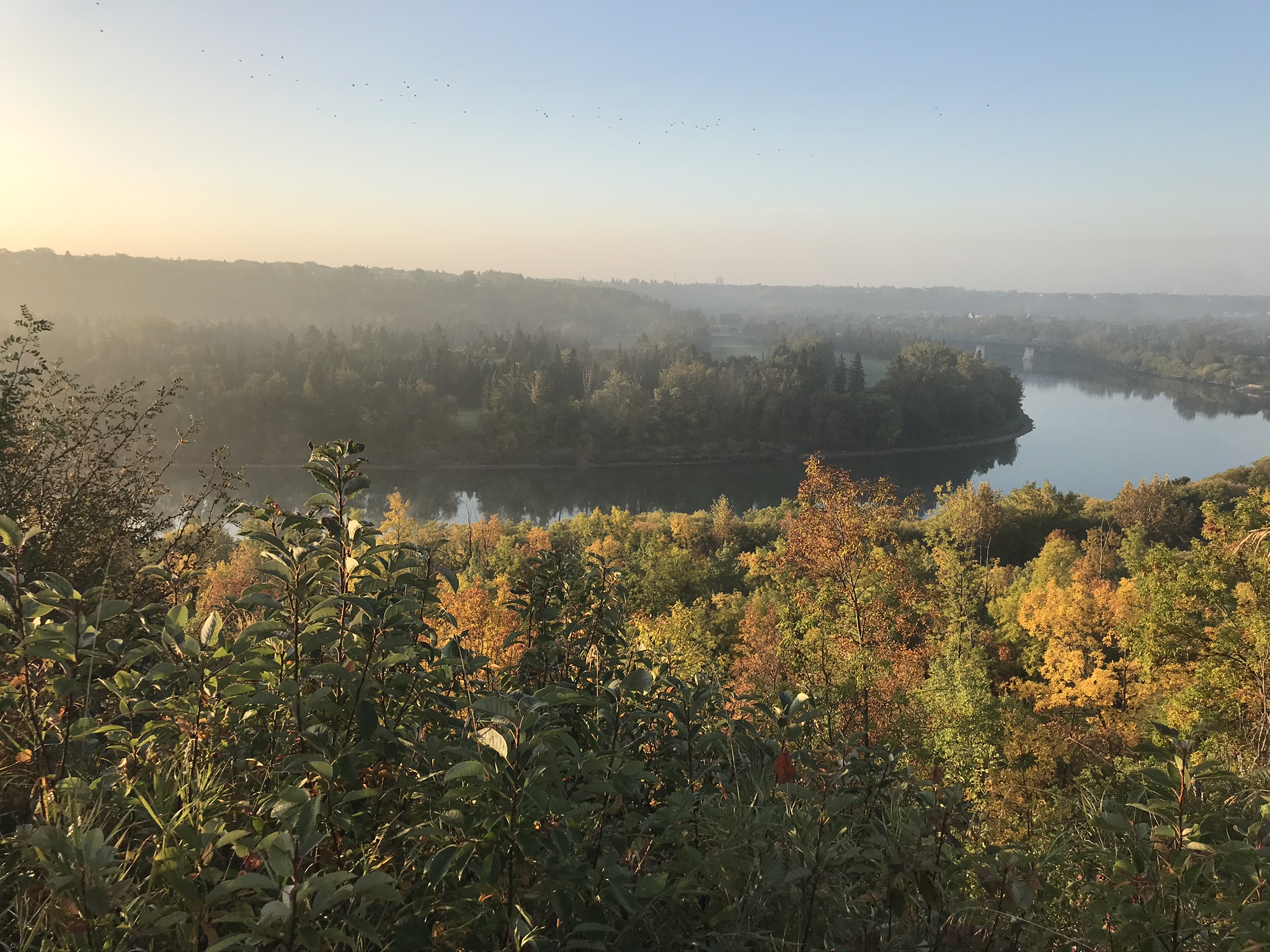
The last couple of days walking by the river, I’ve run across a flock of robins, country robins, judging from the way they spook on seeing me. Maybe they’ll be there tomorrow; maybe they’ll be gone. It’s one of their migration strategies, to stop and refuel every so often. Most migrating birds fly at night. Birds have a compass of sorts in their eyes. They take bearings from the stars, the moon, the setting sun and the land itself. They can actually see the Earth’s magnetic field. They often fly north and fly south on different flyways, routes that arc to follow food sources. These robins may fly to the mid-States, or the Gulf coast, or as far as southwestern Mexico before they’re done.
Equinox anywhere in the world, is migration. Compelled by a mysterious memory, an ancient faded connection to a lost half of planet home. Most bird species will go in waves, first males, then adult females, and then the young, who somehow find their way to the same location as their parents without ever having seen it before. Scientists call it, “site fidelity.” There are always obstacles: skyscrapers, storms, fires. There is always death, but this year is different.
Birds are a sentinel species. Harbingers. Sensitives some might say. The literal canaries in the coal mine.
As the smoke wafted north to my home province of Alberta this past week and human tragedy unfolded along with the west coast wildfires, the birds may be telling of an even greater tragedy on the horizon: catastrophic climate change. This year, migrating birds are dying in “unprecedented” numbers, perhaps hundreds of thousands. Reports started coming out in the middle of August from Arizona, New Mexico, Colorado, Texas, and four northern states of Mexico. Small birds, songbirds: western bluebirds, swallows, flycatchers, warblers, sparrows. Starving some said, no fat reserves left. Acting odd, dying in the open. Dozy. Disoriented. Falling out of the skies; many of their faces dented as if they had flown right into the ground. No one knows for sure the cause yet or if there is any one cause (drought, freak snowstorms in New Mexico, wildfires all down the west coast, habitat loss, delicate lungs) but so far most of it points to one common root: climate change.
Scientists say some birds have already started to adapt to climate change, shifting their nesting grounds further north and beginning to migrate earlier than 30 years ago. There’s also fewer of them: some scientists say we’ve lost three billion birds since the 1970s. There’s a place for fire in the ecosystem: habitat that’s recovering from a burn is at its peak for diversity, flora and fauna. Burned habitat can lead to a greater diversity in the very “language” (the calls, the songs) of some bird species. But can this diversity be sustained through successive, back-to-back fire events? Scientists think some birds are inextricably tied to a particular place. Once it’s gone, can they ever return?
Birds are harbingers. Humans and birds are among the few species that can make song.
When Rachel Carson wrote Silent Spring in 1962 about the environmental fallout of DDT and other pesticides, it was the stories of dead birds and the thought of a planet without bird song that compelled her. After Carson’s book and the legislative and regulatory changes that were made, many bird populations did start to recover. And humans were better off for it.
Birds are sensitives. During this time of COVID, when I’ve had to slow down, travel closer, consume less and contemplate more, it’s harder to avoid the questions: What would the world be without a place to nest? To hunker down? To call home? And what would Equinox be without migrating birds?
Birds, birdsong, nesting sites and climate change. It’s all simply too much for most people and the anxiety is taking manyt people to a space of total apathy. I can’t fix it so I’ll do nothing… seems the call.
I have done all I can do in my world to mitigate my role in the overburdening of the planet. Covid is helping as folks reacquaint themselves with family, back yard and friendly barbeques right at home instead of a few hundred gallons of fuel later. Same with travel. Less … not happy making but good for the lungs of the planet.
My farm operates 6 of 12 months on solar energy; the wetlands are fenced and full. Full of wildlife to bugs. The gardens are filled with bees and butterflies for as many months as I can possibly manage. Four compost bins built myself. Rotational composting. Serves the land very well. Chipper chips all the bits and pieces cut from thinning trees on the yard and saving for a day’s chipping. The gardens are composted and mulched. And, there is much more that needs doing. How does everyone play their role? Perhaps Covid is ensuring more at home learning time. Planting a potatoe, a row of corn, a pumpkin plant. There must be symbol created especially to indicate the Hummingbird Story… Hopefully you know the Haida story of Little Hummingbird and her beak full of water back and forth, back and forth to the raging forest fire. “Just doing what I can” she says to the bear who is shouting at her to “get out.” “Just doing what I can.” And hoping against hope that others are doing what they can also. We dodged a big one this spring. No fires on my land. None coming either. I have things I can do.
Pearl, Thank you for sharing the Haida story of the hummingbird and your own story too.
Re: Pearl Gregor’s note. I haven’t figured out what “doing what I can” might be in my case, but it is definitely not building compost bins and planting potatoes!
Yes, well, your apartment balcony might get a little cramped if you try to do both, Anita;) Thanks for weighing in.
Audrey, there was a really lovely film that came out in Québec last year called Il pleuvait des oiseaux (And the Birds Rained Down – shown at TIFF). It’s about many things but mostly about senior characters, living off the grid in rural Québec, who can smell a forest fire and it reminds them of another fire when they were younger when the birds fell from the sky. Harbingers indeed. Thank you for the trajectory…:)
Sounds like a good film and sobering.
Hi Audrey,
Really enjoyed your article. Strange as it might seem, the obvious lack of birds has been a frequent topic Of conversation with the people we socialize with. We too, believe it is climate change; next question could be.. are they gone forever ??
Thanks for sharing..
Gord Whitson
That was the question in 1962 too:) Thanks for your reflections, Gord.
Audrey, I look forward to reading your personal seasonal stories, of Autumn. Winter, Spring, and Summer. ANIMA MUNDI COSMIC evolution continues to evolve in OPPOSITES ~ the Energy to birth to die ~
Always good to hear your wisdom, Jano.
Beautiful to read your reflection, Audrey. I am just home from New Moon camping where I was serenaded by Great Horned Owls, Mourning Doves and Coyotes. An eye-ball-to-eye-ball encounter with a Golden Eagle has been a highlight of 2020. And so, this week I’ll be out again, masked, hopeful and heartbroken to stand with the kids at Fridays for Future/Extinction Rebellion demonstration here in Calgary.
Thank you for sharing your witness and your love, Carolyn.
Thanks Audrey,
Always enjoy your writing!
Colin and I were out walking quite a bit this year and he thought there were fewer birds this year, in total and in variety. As you note so eloquently in your blog climate change is taking its toll.
I saw two blue jays the other day right in my neighborhood! That’s quite unusual because they tend to stay in the suburbs. They were so beautiful.
I hope we (Canada and countries) can commit to doing what it takes to repair the earth. I don’t even want to think of a world without birds.
I hope all is well with you and yours in this difficult time.