
Summer Solstice 2026: A Mingling of Voices
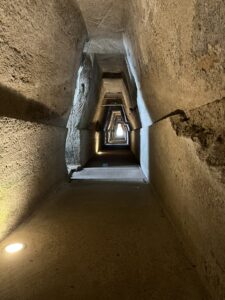
The legendary Cave of the Sybil, Cuma
In the spring of 2019 I visited Agrigento in Sicily, a huge, ancient pilgrimage site of Greek temples. It was only at the end of the first day that I came upon the ruins of temples for Demeter, Persephone and Dionysus, what the sign called “the chthonic deities.” I felt a spirit there that I felt nowhere else in the complex. Only the outlines of modest shrines lie in the grass, not grand columns. They were interspersed with small wells and altars with openings into the earth for simple offerings, mostly libations of wine and oil. Gifts of the earth returned to the earth. I was puzzled by how moved I felt there, not knowing why these were called the chthonic deities, knowing only that it was the oldest part of the site. They embodied the spirit of the Earth, I know now, and their cult probably pre-existed the Greeks.
I was back in Italy this spring and visited sacred sites at Pompeii, Paestum, Tarquinia, Rome and others, but the place where I was probably most moved was at the temple of Apollo at Cuma. There are five Sybils in the Sistine Chapel, considered the prophetesses of the classical world; one of them is from Cuma.
The morning I arrived at Pozzuoli near Cuma, I headed down the hill to the centre of town to find the bus. I asked the locals for directions in my broken Italian. Ahead, they told me. Another block. Around a corner. Finally, I stopped a woman about my age coming out of an automotives shop. She spoke English. Oh, she said, I don’t think there is a bus. Too early in the season. But let’s check with my friend. We went back into the shop she had just exited.
This extranjera (stranger, foreigner) wants to go to Cuma. How can we help her?
Her friend pulled up the bus schedule on their computer. No bus to Cuma, he confirmed. Well maybe I can take a taxi? The two of them conferred in a blizzard of Italian. No, no, my newfound friend said. And her friend chimed in. No, no taxi. I’ll take you she said. Let’s walk back and get my car. She showed me her work studio and then we hopped in her little Volkswagon. It turns out Vanda Ferrante was an artist, (I do contemporary art, she told me), and she lived right beside Cuma.
As we sped wildly through the roundabouts to get to Cuma, Vanda gave me a running history of the area—the early Greeks, the Roman road we were on, all the ruins along the way, the volcanic lake, and on. She dropped me at the gate with a hearty buona giornata! and disappeared. Not unlike a winged creature in a chariot out of Greek mythology. I still haven’t been able to locate her on the internet.
When I arrived at Monte di Cuma, I made my way up the Sacred Way to the first terrace and then the upper terrace and the temple to Apollo. (In antiquity the Sacred Way divided the temple sites from the daily life of the populace.) There was hardly anyone else at the site. The interpretive signs told the story. Though Greek in name, Cuma, like most sacred sites, is probably a composite of many layers. The Temple to Apollo wasn’t the first or the last shrine to be built there. The earliest were built by peoples whose names are forgotten. The Greeks built and rebuilt the temple to Apollo several times, then the Romans and finally the Christians. Only the bones of the basilica remain. What has remained constant in this place are the foundations: the mountain, the sea, the fields, and the sky. The wind blowing through the trees as it was the morning I was there. And the mingling of the voices of the people and the land through changes of fortunes, empires, and civilizations.
In Greek mythology Apollo was the older brother of Dionysos and the god of light, healing, prophecy, music and the arts. The chthonic deities were concerned with the central mysteries of life: The growing and the harvesting of things and of lives. Death and rebirth. Timeless questions.
As we celebrate this National Indigenous Peoples Day, may we listen for that mingling of voices. May we ask questions of Earth. May we honour the mystery.

11 Comments
Faith Fernalld
June 21, 2026I loved this story of the serendipity of travel. It brought back memories of chance encounters with strangers when in other countries. It is an advantage of travelling on your own rather than on a tour. People must be intrigued that a North American “extranjera” would be so interested in their ruins. You describe the incident so beautifully. Just out of interest, how did you get back to your B and B? Were you able to call a taxi? Cell phones have revolutionized travel.
Anita Jenkins
June 21, 2026I had the same question. How did you get back from Cuma?
Audrey
June 21, 2026Well, I see I left a cliff hanger;) I wasn’t sure either how I was going to get back that day, but solutions (not the first or last time) did seem to fall from the sky in Italy, so I didn’t think much about it till I reached the gate again. I could have called a taxi, but I ran into a gaggle of Slovenians who told me there were buses to another town and from there they took the regional train back to Naples. But I really wanted to take the bus back to Pozzuoli to see the Flavian Amphitheatre which I hadn’t had time for in the morning. (It is the third largest in Italy.) So I was able to work out with a driver where he could let me off so that I could catch a connecting bus for Pozzuoli. And from there I caught the train back to Naples. It was just perfect. I met many angels along the path.
Linda
June 21, 2026As always my friend, you bless this solstice day with an invitation to pause and ponder the ever unfolding mysteries of this Life through which we journey, one species among many ….all expressions of a Great Mystery within which we live, love and have our being. With gratitude, as always, for your seasonal wisdom sharing…
Audrey
June 21, 2026“A Great Mystery.” Thank you, Linda.
Carolyn Pogue
June 21, 2026Your words ground me. Thank you for a reminder of the ancients, the kindness of strangers and the deep, deep stories of Earth spirit.
Audrey
June 22, 2026Thank you for walking along beside me, Carolyn.
Kate
June 22, 2026So glad to hear the resolution of the cliff-hanger. Phew! (Well I knew you were all right but I did look up the distance back to Napoli.) Thank you for those moments – what the French call “frissons” – where you just know something bigger is all around you. Of course, I couldn’t help but wonder if Vanda and Elena are related. But it’s a relatively common name… Audrey, I look forward to hearing more about the trip as your reflections have time to unpack.
Audrey
June 22, 2026Oh, that took me a minute to follow. Elena Ferrante, the Italian author! Who is herself an elusive pseudonym … Well could be. I’m still pursuing Vanda’s contact info. I’ll keep you posted. Meanwhile, thanks for the word, frissons. Lovely.
M. Jano Thibodeau
June 26, 2026GREAT STORIES TO DREAM with during night time awake – old age keeps me in if only -if only –
thank you Audrey – je t’aime toujours – ~j.
Audrey
June 29, 2026True, Jano. Dreams provide the vision. Thank you for your faithfulness to the path.