Blog

  • New York Valentine

    A year ago at this time, I was in New York for seven days. By mid-week I was hunting in earnest for an I HEART NY sticker, suddenly understanding the meaning of all those I HEART stickers from around the world, derived, I realized, from this Mother of all HEART stickers. New York is a creator’s heaven. Probably a foodie’s heaven and a shopper’s heaven too, though I am an unorthodox foodie and an unenthusiastic  shopper. Every day: theatre, musicals, opera, jazz, amazing meals, rich art. I came back sated and inspired in my own writing practice for many months afterwards.

     This February, I was at Banff Centre for a week, which is like a second heaven for any artist: so much creative energy gathered in one place, so much natural beauty to touch, not to mention the heaps of award-winning food doled out three times a day. And where else do they give you an ID card that has ARTIST in capital letters under your name? I always say it’s the best scenery in Canada at 30 below, And yes, I would say I HEART Banff Centre.

    In both places, there’s a many-layered energy, that owes a debt to generations of creative people who have dared over and over again to present their dream-visions of the world. On my Banff retreat, I took with me Eugene O’Neill’s Complete Plays. Most were first mounted in New York. He was a complex man with many personal demons and great hopes, all of which come through in his characters and their relationships. He wrote about racial prejudice, gender stereotyping, religious hypocrisy, and dysfunctional families long before any of these themes were in vogue.  Some of his plays won Pulitzers; some bombed O’Neill won the Nobel Prize for Literature in 1936.  Of perhaps his most famous play, Long Day’s Journey into Nightabout a family in deep pain, O’Neill said that he had written it “in tears and blood… with deep pity and understanding and forgiveness for all the four haunted Tyrones.” 

    In the end, what makes the soul of a place, whether a Centre on the side of a mountain or a metropolis with a chilling east wind, is heart. This practice towards a vision, this piece of ourselves we each leave behind as we pass through, literary or not, builds the heart of a place and will be built upon by those who follow. It’s similar to the feeling I get when I walk into a centuries-old churchyard or a circle of standing stones. Many people have come before me, lived their lives fiercely and boldly, and I owe it to them to risk too.

    Happy Belated Valentine’s Day!


  • Mystery

    DSCN5184 I went for a walk in the river valley this morning. I was thinking about aging and loss and death. I have several elderly friends and relatives in their 80s; most are struggling in some way. One friend wrote me in his most recent letter that “Mr. Alzheimer” is visiting him more often now. Another lives with severe chronic pain when he walks. All live with the loss of life-long friends and loved ones. I feel at my age as if this part of life has just come into view. A former workmate and friend died from a massive stroke last winter while on holiday with her daughter. She was only 54. Another colleague from writing and editing circles died Saturday afternoon. She was 56.

    As I walked this morning and the ravens wheeled and squawked overhead, I was thinking about all these people, about the why of life and death. The frozen river had no response. Only the sun, which seems to not to have been seen for months, dared to shine, so bright. As if the dark and cloud and falling snow of winter had fled in the night. Then I thought of something else, what a friend to the woman who died Saturday wrote after her last visit Friday and as witness to the passing: “It is a mystery.” And that was all and everything that could be said.

  • The Layers

    New Year’s Eve I was at a small party with friends in the neighbourhood. There was food and drink and fire: candles in the snow, candles in the windows, and a bonfire out the back porch. The bonfire was best of all. On small scraps of paper, we wrote down the things we wanted to let go of in 2013 and the things we wanted to embrace in 2014. We threw them into the fire. We chased each offering with handfuls of flour and made small explosions of light. The sky was black and clouded over in places, though the hostess said there was a new moon. Then someone read the poem The Layers by Stanley Kunitz, and I felt riveted to the ground. I had never heard it before. All I could think was how much I feel this too, this looking back at the “milestones,” the path I’ve taken, how I keep changing. How none of it was what I had imagined: the losses I’ve endured, we’ve all endured along the way; the loves. And the mystery of the road, how no matter what, I want to keep walking. Read the poem. 


  • A Thousand and One Doors

    A Thousand and One Doors


    Lately, I’ve been reading The Arabian Nights, or what has been traditionally called The Thousand and One Nights, translated by Husain Haddawy from a 14th century Syrian manuscript, the oldest there is. Haddawy grew up hearing the Nights around his grandmother’s hearth on long winter nights in Baghdad.

    The book could easily be called The Thousand and One Doors. Doors open: doors to Kings’ palaces, doors to the street, doors into the earth or into lost worlds.  Strangers, trusted advisors, the sons and daughters of kings, even demons, enter. Stories enter: three one-eyed dervishes, a lake with fish in three colours, a woman turned into a cow–fantastic stories–and a young woman named Shahrazad presides over their telling.

    The Nights have got me thinking about the uncanny resemblance between doors and books. Medieval book covers looked and felt a lot like doors.  Book covers were usually made from wood then covered in leather and had the same shape and a similar function, opening the reader to worlds, sometimes familiar, sometimes not. An article at the Getty Museum  even describes one medieval book that has a miniature medallion at its centre, made of parchment scraps arranged and dyed to look like stained glass. A window? And when you think of it, isn’t that how life often presents itself? A series of doors and windows? Opening in and out, again and again, to the unknown? Unpredictable and upside down from how we imagined it? When I visited Andalusia in 2009, what the Moors once called Al-Andalus, I was enthralled with the doors, so like medieval books. I came upon the one shown, here, with the eight-pointed star, a sun symbol, inside the Alhambra.

    And so comes a familiar door. The longest night of the year is upon us again and the shortest day, when the sun stands at its lowest point in the sky; stands still, then turns. For the ancients, this day was a door, an opening into a new year.

    May you grasp hold and find blessing in that opening. May you find strength to face any woe. May a labyrinth of stories sustain you.

    Happy Solstice,

    Audrey


  • Walking Night

    I love walking at night this time of year, especially when it’s mild. I can leave my hood down and listen and see and be touched. Maybe there’s laughter or music from a house party at the end of the block. I may run into a snowshoe hare or pass through light pouring out of someone’s picture window. I may watch the moon rise.

    I think this love of darkness and its contrasts (like my love of summer thunderstorms) came early, growing up in northern Alberta. I often went for a night walk through the pasture or hayfield or along the road allowance that ran east of our farm as a kid. I remember our grade five science book had a chapter on stars and we had to stand out at 30 below (Fahrenheit) and find all the constellations. I went out every night after supper and kept going out, long after the assignment was done. And when I think about it, what I still like about walking at night is the feeling of being alone in the universe, and at the same time, being lifted up and embraced. I wonder if it’s the same feeling we have in the womb. Whatever it is, I never cease to be thrilled by the fall of night.

  • Writing Food

    I’ve recently discovered Ruth Reichl,  who some will call a food writer; I think she’s first and foremost a storyteller. She’s the author and editor of  several books, former restaurant critic for the New York Times, the Los Angeles Times, Editor-in-Chief of Gourmet Magazine and other lauds.  I’ve just finished Comfort Me with Apples and For You, Mom, Finally.  Her books are about food (there are recipes every chapter and most of them have an emotional connection), but they’re also about the relationships that happen around food, the hope and heartbreak of every life: birth, death, passion, loss, family and friendship told by an extraordinary human being. For You, Mom, Finally is about her relationship with her mother. Ruth’s mother was bi-polar and when her mother was manic she loved to entertain, often with food that was well past its best before date. It was an intense introduction to food, one that  profoundly shaped the author. Reichl reminds me in some ways of another memoirist, Kate Llewellyn, an Australian, whose garden (The Waterlily) and travel writing are likewise filled with allusions to affairs of the heart.

  • All Hallows-Martinmas 2013

    It is St. Martin’s Day,
    we’ll eat chestnuts,
    we’ll taste the wine.
    Traditional, Portugal+

    This is the season of extremes. The land on fire and the land laid bare and all of it happens within a few short weeks, as if the earth blazes in glory before giving itself up to the quiet rest of winter. Last Sunday when I went for a walk, there were bands of colour laid on the sidewalk and against the dusting of snow: leaves of maple, elm, and mountain ash; golden, brilliant yellow, or scarlet-rust; here and there at sudden intervals; felled by the sudden freeze the night before. It is in these turnings, split seconds in Earth’s life, that the ancients believed we are opened to decision points.

    In ancient times, All Hallows Eve marked the start of an eleven-day feast that ended with Martinmas on November 11th. Martinmas coincided with one of the old Celtic Quarter Days (quarter for “four”) positioned midway between equinox and solstice. During this fall festival, harvest fairs were held, tenants and servants hired or dismissed, livestock slaughtered, and new wine tasted. In Scotland they now call the old Quarter Days, Term Days. There, they are still turning points, marking when contracts and leases begin and end and when interest and rents are paid. Martinmas is still celebrated in parts of Western Europe with bonfires, parades, lanterns, and candy for the children.

    I wonder if my fondness for this time of year is due, at least in part, to the discovery that my Great-Great-Aunt Agnes Whitson was married on Martinmas in 1835 in Swinton Parish, Scotland. Not long after, she, her new husband and her two brothers (or by some accounts cousins) sailed for Canada. In Scotland, they were tenant farmers. In Canada and Southern Ontario, they were settlers and landowners. I imagined them saying their goodbyes to family and friends and neighbours during the long harvest festival, of looking on during the hiring fairs, and once married, taking the road to the nearest port with ships to Canada, probably Glasgow. Our lives are the result of many such decisions, momentous and dramatic and everyday.

    Lately, I’ve been wrestling with a decision of my own. I liken it to struggling to catch my breath (my spirit), tossing and turning in the night, wrestling with an angel and not wanting to let go without a blessing. First, on one side and then on the other, each side presenting a different choice in my mind, each a different road. The more I try to control the outcomes, the greater the struggle. When I can let go though, when in the night I can see through the windows of my nightmares and come to terms with who I am, I wake up at peace.

    This time between fall and winter reminds me that decisions can be as dramatic and as sudden as that. And as peace-filled.

    Happy Halloween!

    Audrey

    + http://en.wikipedia.org/wiki/St._Martin’s_Day

  • September Launch: Audreys Books

    September 26, an exciting night: sixty-one people in attendance, an abundance of wine, stories and questions. Sixty books were in stock. Last week I couldn’t resist checking to see how many were left on the shelf: 4:)  Thanks to my niece, Alana Whitson, for the photos.

    [slideshow]

    IMG_9020IMG_9019IMG_9080IMG_9090IMG_9130

    [/slideshow]

  • To Bind Together

    “You aren’t religious are you?” a co-worker asked me after she opened The Glorious Mysteries and saw the title of the first story in my collection, “The Baby Jesus.”

    “What do you mean by religious?” I asked her. “If you mean a strict follower of a particular religious doctrine, no,” I said. “But if you mean, like the Latin root of the word, religio, to bind together, then yes, I very much have religious sensibilities. I look at the world as a place of connections.” What I didn’t tell her is that many of my stories critique or subvert the Catholic tradition itself, and I am not alone in this.

    Last weekend I was at a brilliant performance at the Citadel Theatre (in Edmonton) of Eugene O’Neill’s Long Day’s Journey into Night. ONeill’s characters are deeply influenced by Catholicism, often tragically so. Yet the divided family he presents in Long Day’s Journey could be any family dogged by addiction, failing, and disappointment and that is what makes his particular rendering of it, universal, Catholic and all.

  • Fact or Fiction and the Truth of It

    I had the privilege of travelling the province last month reading from The Glorious Mysteries. At Word on the Street, in Lethbridge, I had just finished reading “The Water Witcher,” one of the Alberta stories in my collection. There was an attentive crowd gathered, probably 30 to 35 people. It was an outdoor festival; we were under a tent. The skies were clear and warm, the winds were calm for Lethbridge. A hand shot up. A middle-aged man, dressed in the clean, white work shirt and pants of a painter or other tradesman, had the first question. I had watched during my twenty-minute reading as he paused at the back of the tent, leaned in to listen, and finally took a seat with the rest of the audience. “One thing I want to know, in that story of yours, did they really end up finding water in that place?”

    Often it’s the sign of a good story when a reader is “taken in.” The man was sincere and earnest. I almost didn’t have the heart to answer. “This is a work of fiction, but it could have happened and it does happen.” The man slumped a little lower in his seat, clearly disappointed. The context is southern Alberta, the summer of the Great Flood of 2013.

    That got me to thinking about fact and fiction and why our age demands so much of reality. Metaphors seem to pale beside the reality of devastation. There are fundamental parts of our world that are out of balance. And yet I would argue that stories illuminate and hold out more hope for the future than all the facts in the world. Just saying… but then I am a writer.

  • London in the Kinnaird Ravine

    London in the Kinnaird Ravine

    Sometimes a day’s weather reminds me of another time and place. This morning in the Kinnaird Ravine it felt to me like London, England in fall. The mingling of warmth and rain, the fragrance of rotting and growing things. The way the light is muted by the clouds and stands of old, old trees. The path through the ravine is still wild. You may not think there is any wilderness left in London, but Hampstead Heath would argue back. And just twenty minutes from the centre of London is Greenwich where I visited one fine November day in 2009. If I were to give this photo a caption it would be the title of an old hymn: “How can I keep from singing?” That’s how I felt this morning in Kinnaird Ravine too.

  • Word Witcher

    I have an artist friend who hasn’t been able to finish her website because of all the little decisions that have to be made: colours, text, logo, fonts, message… I understand. Take the business cards I’m trying to finalize for marketing my next book. A few words, a couple of colours, three weeks later and the mock-up still isn’t at the printers because of one niggling question. What do I want to call myself? A writer or an author?

    There’s a huge debate in the writing world about what each of these words means and whether an author is really a writer or just a published personality. Or whether a writer really cares about being published and marketing their work. I confess, I don’t know a writer who doesn’t want a readership. Being published by other people is often a good check that the writing has integrity. Yet there’s no hard and fast on this as anyone in the publishing business will tell you.

    That debate aside, neither author nor writer really expresses all of who I am. I have had many lives. I brainstormed over email one night with another writer friend: so what if I called myself a word witcher? She loved it. Yes, it expresses so many layers of who you are, your rural roots, it makes one think of water witching, spirituality and women’s work.

    I like the idea of word witching, maybe because one of my stories in this collection is about a water witcher (so this is really some clever marketing ploy), but also, like witchers of water, one has to listen to language’s internal rhythms, spirits and intuitions to find the thread of the story or the vein of a poem. It’s often an irrational process, even dream-like and when one finds the mother lode, it is like a minor miracle.

    So what did I decide? Writer or author or word witcher? No one role can describe all of who I am. I think that’s true for most of us. My name is probably the best descriptor there is and so I’ve decided that that’s enough.

  • Lughnasa, August 1, 2013

    Lughnasa, August 1, 2013

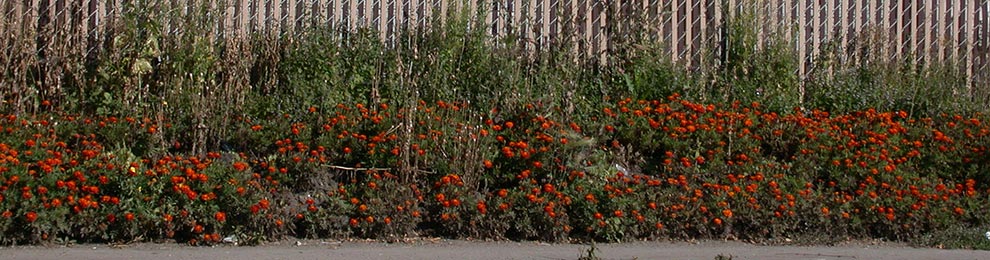
    When I tell people that I live in Boyle Street, they often look a little surprised, even concerned. Yes, some pockets are rough, but some pockets are gold. Maybe it’s because many people here have next to nothing that they make the most of the little they have, why some boulevards, tiny porches and postage-stamp front yards are jam-packed with blooms this time of year. Why people grow marigolds and red poppies right up against 107A Avenue, merry-making of the traffic and the concrete that flows past everyday.

    We are entering the season of harvests. Irish Folklorist, Máire MacNeil, in her tome, The Festival of Lughnasa, relates an old man’s account of a harvest fair held in Lehinch (pronounced la hinge) on the first Sunday in August. He recounts that the fair was full of “tricksters”: musicians, dancers, flame eaters, card sharks, gypsies, young men going from public house to public house, young women in ritual at the well of Liscannor, horse racing along “the strand” and noise everywhere.

    Think of Boyle Street like one continuous harvest festival. Indeed the whole city at this time of year. Full of tricksters and buskers and the bottle pickers on the backlanes heading for festival after festival, that all in some way celebrate the gift of the sun and the land and the growing of things.

    Publishing, too, is full of twists and turns, and my experience no different, full of last minute hitches and hiccups and near snafus. But the book is safely off to the printer at last. I hope you will help me celebrate this harvest of mine: I’ll be launching The Glorious Mysteries and Other Stories in September in Edmonton, Saskatoon, Calgary, Camrose and Lethbridge. Watch for a note with full details later in the month.

    For now, you are invited to the Edmonton launch:

    Where: Audrey’s Books, 10702 Jasper Avenue
    When: 7:00 p.m., Thursday, September 26
    What: Reading and refreshments

    Everyone is welcome. But to help with planning, please RSVP by replying to this email.

    Meanwhile, I hope you will engage in some tricks and shenanigans of your own this harvest season.

    In gratitude,

    Audrey