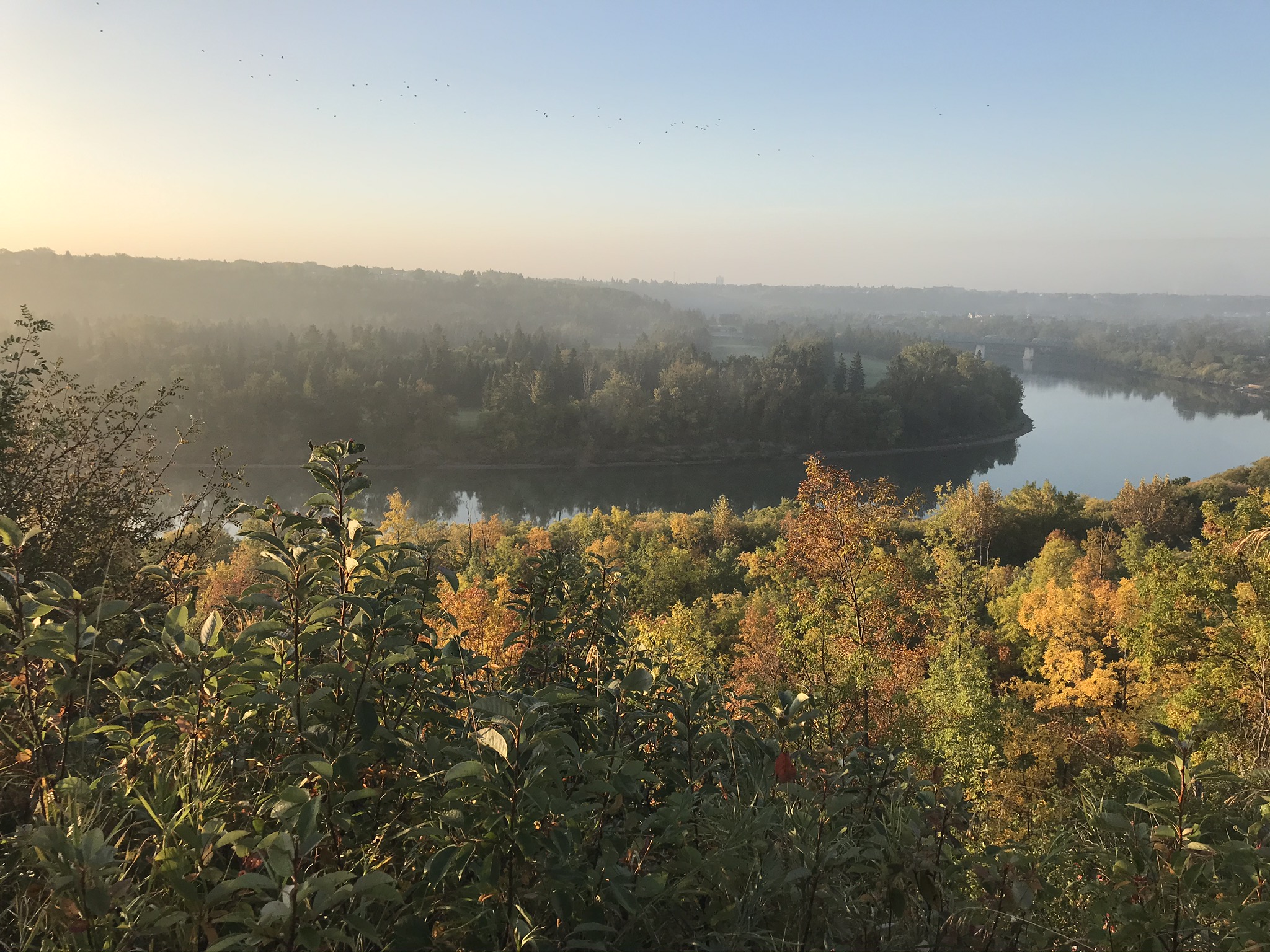
The last couple of days walking by the river, I’ve run across a flock of robins, country robins, judging from the way they spook on seeing me. Maybe they’ll be there tomorrow; maybe they’ll be gone. It’s one of their migration strategies, to stop and refuel every so often. Most migrating birds fly at night. Birds have a compass of sorts in their eyes. They take bearings from the stars, the moon, the setting sun and the land itself. They can actually see the Earth’s magnetic field. They often fly north and fly south on different flyways, routes that arc to follow food sources. These robins may fly to the mid-States, or the Gulf coast, or as far as southwestern Mexico before they’re done.
Equinox anywhere in the world, is migration. Compelled by a mysterious memory, an ancient faded connection to a lost half of planet home. Most bird species will go in waves, first males, then adult females, and then the young, who somehow find their way to the same location as their parents without ever having seen it before. Scientists call it, “site fidelity.” There are always obstacles: skyscrapers, storms, fires. There is always death, but this year is different.
Birds are a sentinel species. Harbingers. Sensitives some might say. The literal canaries in the coal mine.
As the smoke wafted north to my home province of Alberta this past week and human tragedy unfolded along with the west coast wildfires, the birds may be telling of an even greater tragedy on the horizon: catastrophic climate change. This year, migrating birds are dying in “unprecedented” numbers, perhaps hundreds of thousands. Reports started coming out in the middle of August from Arizona, New Mexico, Colorado, Texas, and four northern states of Mexico. Small birds, songbirds: western bluebirds, swallows, flycatchers, warblers, sparrows. Starving some said, no fat reserves left. Acting odd, dying in the open. Dozy. Disoriented. Falling out of the skies; many of their faces dented as if they had flown right into the ground. No one knows for sure the cause yet or if there is any one cause (drought, freak snowstorms in New Mexico, wildfires all down the west coast, habitat loss, delicate lungs) but so far most of it points to one common root: climate change.
Scientists say some birds have already started to adapt to climate change, shifting their nesting grounds further north and beginning to migrate earlier than 30 years ago. There’s also fewer of them: some scientists say we’ve lost three billion birds since the 1970s. There’s a place for fire in the ecosystem: habitat that’s recovering from a burn is at its peak for diversity, flora and fauna. Burned habitat can lead to a greater diversity in the very “language” (the calls, the songs) of some bird species. But can this diversity be sustained through successive, back-to-back fire events? Scientists think some birds are inextricably tied to a particular place. Once it’s gone, can they ever return?
Birds are harbingers. Humans and birds are among the few species that can make song.
When Rachel Carson wrote Silent Spring in 1962 about the environmental fallout of DDT and other pesticides, it was the stories of dead birds and the thought of a planet without bird song that compelled her. After Carson’s book and the legislative and regulatory changes that were made, many bird populations did start to recover. And humans were better off for it.
Birds are sensitives. During this time of COVID, when I’ve had to slow down, travel closer, consume less and contemplate more, it’s harder to avoid the questions: What would the world be without a place to nest? To hunker down? To call home? And what would Equinox be without migrating birds?
