Author: Audrey

  • Winter Solstice 2020: A Deepening

    Growing up I was afraid of the dark. I was afraid of going to bed at night. I was afraid of going down into the corners of the basement in the middle of the day, where I would often get sent to fetch things. Mostly I was afraid of the unknown. What I might find there.

    I have come and left, come and left in my Edmonton neighbourhood three times in the past 30 odd years. The first two stays were short: a summer break spent in a heritage home near 97th Street, a year and a half near 95th Street in an Italian bungalow built like a bunker, and more recently 8 plus years off 92 Street, east of the LRT tracks.

    When I first started living here those many years ago, I had an imaginary security system in my head. Day or evening, it didn’t matter, I had an elaborate map of homes of friends and acquaintances on each block, and I would time evening walks and trips to the grocery store to coincide with some of these locations. If something should happen to me down this block, I reasoned, I could knock on this or that person’s door and someone would let me in. I never had to use it in all the years I’ve lived here.

    Something changed in the decades of my coming and going in the neighbourhood. This section of town still has a high transient population and a high crime rate, but somewhere within, something changed in me. I kept being drawn back by the differentness, by the diversity. The Other no longer seems other or perhaps I recognize the other in me too. When I go for walks in the neighbourhood now, I don’t scout out the safe doors. I go without expectation of any kind. This doesn’t mean I live without fear. But I’m getting better at accepting my fears, at accepting the risks of living. This is a metaphor for how I feel in the world now, venturing further and further each day, and feeling at home in it. I imagine someday I will feel so at home, it will be time to go.

    Loss comes to us sharply at this time of year and this time in human history. This pandemic has demanded a deepening, a going inside the self, with nowhere to hide, no defenses, or distractions but unadulterated reality. This is the reckoning. What is important? What feeds my soul? What starves it?

    Night is not without light or colour: Planets. Stars. Galaxies. The moon in all her phases. For those of us in the higher latitudes, the northern lights.  What if darkness and light are not necessarily opposites, but mirrors of each other, real by contrast, fundamentally connected?

    Some limits we grow through. Some are temporary and we learn to weather them. Some spur creativity and innovation. Then there are losses which are irretrievable. The loss of a child, a loved one. A people. A language. Species loss.

    Perhaps this season is most about Mystery. The reality of death and the continuance of life and the dance between them. Because there is space, story can enter in. Memories of people and place. Imaginings of what could be.


  • Fall Equinox 2020: The Birds Are Sentinels

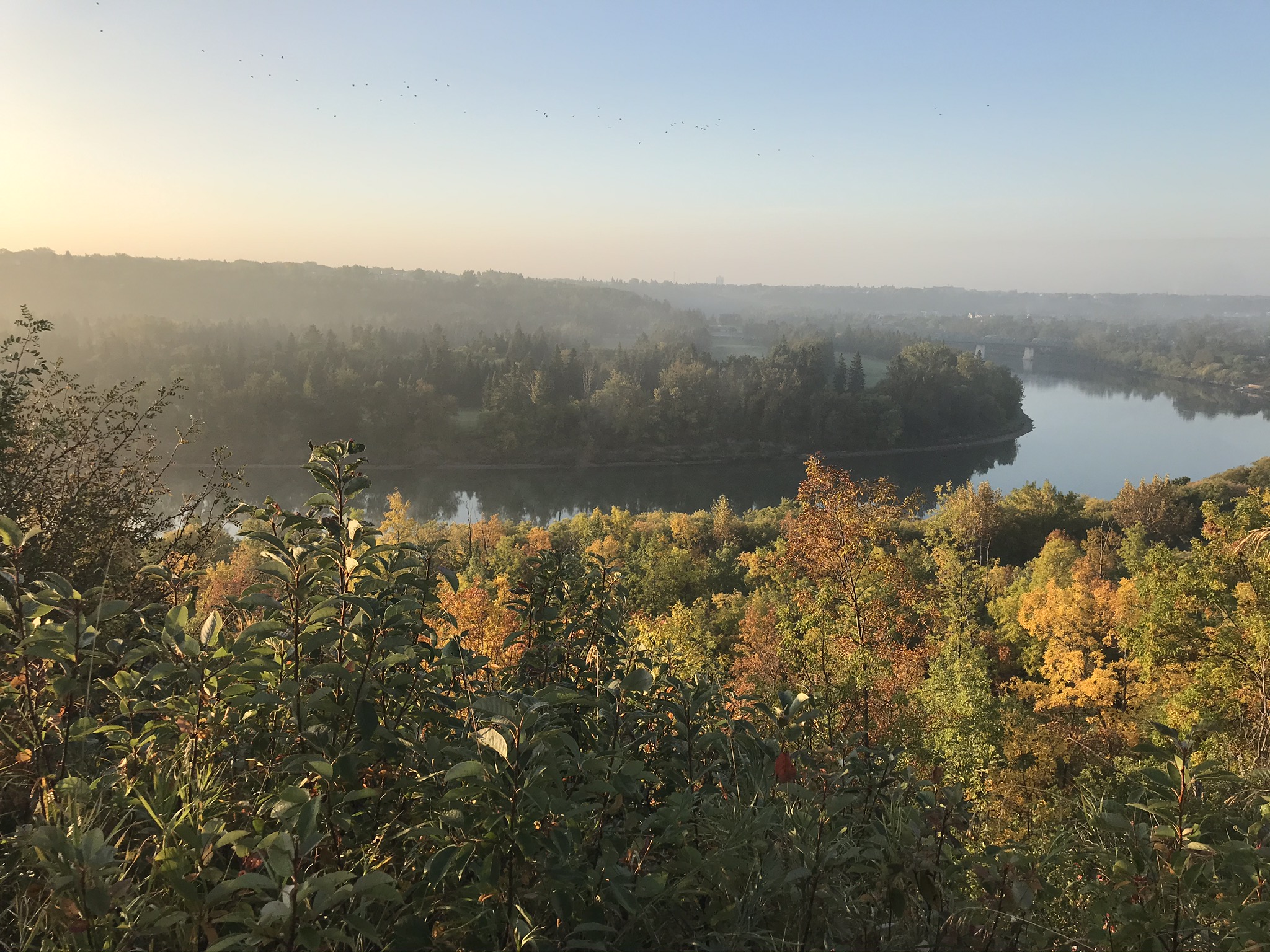
    Where I usually walk: along the North Saskatchewan River with smoke from the West Coast wildfires (Sept 17, 2020).

    The last couple of days walking by the river, I’ve run across a flock of robins, country robins, judging from the way they spook on seeing me. Maybe they’ll be there tomorrow; maybe they’ll be gone. It’s one of their migration strategies, to stop and refuel every so often. Most migrating birds fly at night. Birds have a compass of sorts in their eyes. They take bearings from the stars, the moon, the setting sun and the land itself. They can actually see the Earth’s magnetic field. They often fly north and fly south on different flyways, routes that arc to follow food sources. These robins may fly to the mid-States, or the Gulf coast, or as far as southwestern Mexico before they’re done.

    Equinox anywhere in the world, is migration. Compelled by a mysterious memory, an ancient faded connection to a lost half of planet home. Most bird species will go in waves, first males, then adult females, and then the young, who somehow find their way to the same location as their parents without ever having seen it before. Scientists call it, “site fidelity.” There are always obstacles: skyscrapers, storms, fires. There is always death, but this year is different.

    Birds are a sentinel species. Harbingers. Sensitives some might say. The literal canaries in the coal mine.

    As the smoke wafted north to my home province of Alberta this past week and human tragedy unfolded along with the west coast wildfires,  the birds may be telling of an even greater tragedy on the horizon: catastrophic climate change. This year, migrating birds are dying in “unprecedented” numbers, perhaps hundreds of thousands. Reports started coming out in the middle of August from Arizona, New Mexico, Colorado, Texas, and four northern states of Mexico. Small birds, songbirds: western bluebirds, swallows, flycatchers, warblers, sparrows. Starving some said, no fat reserves left. Acting odd, dying in the open. Dozy. Disoriented. Falling out of the skies; many of their faces dented as if they had flown right into the ground. No one knows for sure the cause yet or if there is any one cause (drought, freak snowstorms in New Mexico, wildfires all down the west coast, habitat loss, delicate lungs) but so far most of it points to one common root: climate change.

    Scientists say some birds have already started to adapt to climate change, shifting their nesting grounds further north and beginning to migrate earlier than 30 years ago. There’s also fewer of them: some scientists say we’ve lost three billion birds since the 1970s. There’s a place for fire in the ecosystem: habitat that’s recovering from a burn is at its peak for diversity, flora and fauna. Burned habitat can lead to a greater diversity in the very “language” (the calls, the songs) of some bird species. But can this diversity be sustained through successive, back-to-back fire events? Scientists think some birds are inextricably tied to a particular place. Once it’s gone, can they ever return?

    Birds are harbingers. Humans and birds are among the few species that can make song.

    When Rachel Carson wrote Silent Spring in 1962 about the environmental fallout of DDT and other pesticides, it was the stories of dead birds and the thought of a planet without bird song that compelled her. After Carson’s book and the legislative and regulatory changes that were made, many bird populations did start to recover. And humans were better off for it.

    Birds are sensitives. During this time of COVID, when I’ve had to slow down, travel closer, consume less and contemplate more, it’s harder to avoid the questions: What would the world be without a place to nest? To hunker down? To call home? And what would Equinox be without migrating birds?

  • Summer Solstice 2020: The Fullness

    COVID-19. One word with so many contradictions: death, innovation, anger, selflessness, anxiety, adaptation, depression, creativity. The fullness of life! To date, at least 8,457,305 infections; 453,882 deaths. We hear the counts every night like reports from a war zone. We know it is not gone. The financial fall-out we haven’t begun to comprehend. The isolation affects all of us differently. For me the last few months have been like living in slower motion.

    Focus sharpens in times of illness. We come face to face with mortality. We have time to think. We see and hear in ways we haven’t before. This slowed down time, this slower motion has revealed itself to me like a kaleidoscope, the changes going on around us and within us. We see the turn of the seasons close up. A birds-eye view, this time of concentrated inward reflection in the world. This time of intentional watching has revealed the contrasts and contradictions: Black and Indigenous lives matter! People can work at home and be productive. Children and parents have more time to bond. Those already isolated find they have more ways of accessing the world online. We can cut greenhouse gas emissions, just like that.

    We have to be still. We have to listen. We have to be.

    I offer three strategies for COVID, think of them as spiritual practices. From my own experience: Walk. Walk more. Give thanks.

    Walk or whatever movement you can manage. I had a sprained ankle for the past six weeks, so sometimes that movement has been guarded, sometimes limited to watching the movement of light, wind, and life outside my window.

    In the river valley, I’ve found my way around paths I was afraid to follow before. The Dawson-Kinnaird parks are riddled with animal and human trails in hidey-hole places. I’ve taken them, daily, sometimes twice daily, and learned their routes as I’ve followed my feet. When there was still snow on the ground and long before the leaves, I followed the trails, winter into spring, spring into summer, knowing them one layer at a time, when I knew I couldn’t get lost. And now I can’t. (For the full unfurling I’ve witnessed this spring, visit my twitter feed @audreyjwhitson)

    Walk more. Make a pilgrimage where you live, another practice I’ve taken up. A pilgrimage in honour of Saint Brighid suggested by a friend of mine in the neighbourhood with Irish heritage, Kate Quinn. I set out on this walk at least once a week early in the morning. During COVID, the streets are quiet. I see the occasional fellow drinking coffee on their deck, smoking a cigarette, searching for bottles in the dumpster or walking like me. Everyone is friendly. I don’t remember a time when I felt so comfortable talking to “the stranger.” We know we’re all in this “unprecedented” time together. I stop at the homes of neighbours I know and pray a blessing over the hedge, “May the cloak of Brighid flow over this house.” Occasionally they see me or I see them through the window, but that is not the point. The point is to be present in the void. The point is to ground myself in my world and to come home feeling more connected than when I left.

    Give thanks. The final strategy for COVID is something I’ve learned from another friend in the neighbourhood and have adopted as my own. I’ve kept gratitude journals over the years and prayed lists too. But this is simpler and means more to me. At the end of every day I write down one thing that has made the day extraordinary: some encounter, some event, some exchange. For me that might mean crossing paths with wildlife; experiencing a piece of art in word, image, or sound; a rich conversation with a friend or receiving a comment from a complete stranger. Often something small in the scheme of things.

    Savour the fullness in the nothingness of this time.

  • Spring Equinox 2020: Pregnant with Possibility

    I did not go to Spain this spring. It wasn’t easy to make the decision; I left it till the 11th hour. The Canadian Government (as with most governments) was still giving a Level 1 travel advisory for most of Europe: “Travel and take precautions.” It wasn’t until the WHO declared COVID-19 a pandemic, the infections in Spain doubled in a day, and work told me I would have to self-isolate when I returned, that I saw the writing on the wall. Sometimes it’s a battle to see the trends. Sometimes we don’t want to believe what seems an extreme outcome. This spring equinox a microscopic virus has halted all our best laid plans: our RSPs, our jobs, our studies, all our strategies for economic growth, and our travels. All we want is to go back to “normal.”

    There’s another crisis we are facing in the world right now: climate change. Something we’ve known about since the 1970s but have had a harder time coming to terms with. Something there will be no simple vaccine for. Some scientists call our age the Anthropocene for the huge impact humans have had on planet Earth. A friend, referring to COVID 19, said to me, “Maybe this is how it happens, the death of the carbon economy. With the drop in oil prices and the rise of the tech sector, the rise of the new economy.” Though not without cost.

    It’s worth remembering the roots of the word “economy” come from the Greek meaning home or household and meaning to manage. What does it mean to manage our household and our home, the Earth? Maybe this is the meteor of our epoch. Maybe we have an opportunity in this moment of solitude, of renewed family ties and friendships, cyber work and learning environs, to birth something radically new.

    In Alberta, where I live, spring is like a battle every year: a see-saw between temperature and precipitation. One day it snows, the next it melts. Back and forth, a tug-a-war; the coming of spring can take months. It’s a limbo time, a liminal, in-between time, pregnant with possibility. Change may have many false starts and then seemingly, miraculously, come like an avalanche all at once. Every spring in many ways, a whole new world.

    The day after my decision to postpone my trip, a friend said to me, “Barcelona will still be there next year.” It will and so will we, together.  Another friend forwarded me a note she’d had from a friend of a friend (the wondrous side of social media) quarantined in Barcelona. The contact described the sound, around 8 o’clock in the evening, coming from the street on the first day of the lockdown. Something loud and popping, something exploding and boistrous like the sound of firecrackers. But it wasn’t firecrackers. It was the sound of citizens, everyone out on their balconies, thousands, perhaps hundreds of thousands; everyone clapping for many minutes. Clapping, the neighbours said, for frontline healthcare workers as they battle COVID 19.

    We need to stand together. We need to applaud the heroes on the frontlines of COVID 19 and on the frontlines of the climate crisis. We will survive and we can birth something new, together.

  • Winter Solstice 2019: Death and Life

    Mnajdra Temple and the front door where morning light enters each solstice and equinox.

    There are always thresholds to cross. And there are always choices to make. Every season opens a door. I don’t think it’s a contradiction that people mark midwinter as a major anniversary of loss as well as a time of gratitude. Winter solstice holds both death and life for us.

    When I was in Malta this past spring, I would rise every morning. Walk the two blocks to the public transit station in Buggiba (pronounced BOO-jee-ba), get on one of the many public buses and ride with the Maltese on their way to work into Valetta or across or around the island, along with other tourists speaking French, German, Italian and English. Sometimes I was the only tourist on the bus. Sometimes the bus drivers knew where I was going; sometimes they didn’t. That’s when they would reach out to their seasoned Maltese passengers “Do you know where x is?” or even assign them to me: “Here I entrust this lady to your care.” I would show them my map, mispronounce the site I was looking for. Without fail the locals would get me to my destination.

    I would visit at least one archeological site a day. Some of the sites were more remote, less noteworthy, nothing more than a reconstituted pile of weathered stones. I preferred these lonely sites and could linger for hours among the rocks and the wildflowers, only me and the friendly security guard watching from a nearby trailer. Who were these people who built these monuments to the universe? Malta has some of the oldest surviving temples and necropoli in Europe, some of them aligned to the solstices and the equinoxes. The earliest temple, Skorba, dates to 3600 BCE, older than pyramids, older than Stonehenge, older than Newgrange.

    It’s not magic that attracts me to these sites, but it is their makers’ presence. Like any places in the world where many people have prayed, wept, and sung over the centuries, the earth has a memory. The ancients didn’t conjure the solstices and equinoxes, but they observed and honoured the patterns: the path of the sun in relation to the passage of animals (four-legged and two-legged), the rise and fall of temperature and moisture with the planting and growth of crops, the death and rebirth of souls. These were their compass bearings in time.

    In 2019 as the seasons shift and bleed into each other, as glaciers melt and birds drift into new habitat, as fish forget to migrate, there is something urgent in remembering not a perfect time, not a better time, necessarily, but a time of deep human awareness of our interdependence with the Earth.

    In the Hal Saflieni Hypogeum (3300 BCE), an underground necropolis where some walls still bear the marks of red ochre, the signature of Neolithic burials; no one is allowed to take photographs. In this vast multi-hived chamber, filled with the sound of trickling water, hewed out of live stone, with nothing but antlers, chert, flint and obsidian. The winter solstice sunrise enters through a window in the roof and illuminates another open door cut into the face of an inner temple, a door within a door, within a door. It is this inner temple I look for on my travels and on my journey. It is this inner door that beckons us outward.

  • Autumn 2019: The Mysteries of Human Love

    As I harvest my year this autumn, the experience that stands out for me most is my visit to the Valle dei Templi at Agrigento in Sicily in the spring.

    Agrigento is an ancient pilgrimage site, at more than 2000 acres (3+ sections of land) probably the largest outside of Athens in Greek antiquity. A dozen temples run in a wide swath from east to west over a ridge that looks out over the Mediterranean sea on one side and the modern city on the other. The area was colonized by Greeks in the late 6th century BCE and many of the temples were built then, but many were built later and there is evidence that the rites of Demeter and Persephone were celebrated in the westernmost section as early as the 7th century BCE. Indeed the myth of the Mother and Daughter, of birth, nurture and separation is woven into the Sicilian landscape and coincides with the arrival of wheat in the region. In Sicily and much of the Mediterranean world, planting (death and germination of seeds) happens in the autumn, in time for the winter rains, while harvest happens in the spring. The rites of Demeter and Persephone also took place in spring (Lesser Mysteries) and fall (Greater or Eleusian Mysteries).

    I spent two days at the Valle dei Templi. The first day I did not reach the western side until late afternoon. The eastern temples were so triumphalist, so impressive, engineered marvels of grand columns and arches, commemorating wars won and the labour of thousands of slaves, that I had to stop and look at everything. I took hundreds of pictures.

    And then I crossed a bridge over a road and came out at the Fifth Gate, the area they call The Sanctuary of the Chthonic Deities. Chthonic meaning subterranean, underground, of the Earth. The Chthonic Deities are Demeter, Persephone and Dionysus.

    At the Sanctuary, I came upon wild flowers, wild grasses, and only the scattered foundations of temples, small enclosures and the remains of old wells. I wandered and sat, wandered and sat until the middle of the evening, feeling hymns from the ground, feeling a presence, imagining women coming and going through the fifth gate at all hours, passing first by the row of craft workshops outside the gates where terra cotta votives were shaped and then climbing to the Hill of Temples with prayers and questions.

    I returned on my second day to wander and wander again through the ruins of the Sanctuary. A wild and lonely place but also a place of joy. Small altars still stand, most with holes in the middle for offerings to the earth, a place for the clay bothros, cylinders, containers of so much longing, thanksgiving. Plant and animal sacrifices. Layers upon layers of prayers, dug into the earth with votives; archeologists have found statuettes of Demeter, Persephone, miniature clay body parts in need of healing, oil lamps everywhere. Evidence of rituals that connected the living world to the underworld and the world of the dead.

    Today not much is known of the Eleusinian Mysteries except that initiates experienced a dramatic re-enactment of the myth of Demeter and Persephone. An ancient prophetess, Diotima, whose account of the Mysteries probably lives on in Plato’s Symposium, revealed one of its central teachings: that “the purpose of love is birth in the beautiful, both in body and soul.” From the same source, we know that birth in the beautiful for the initiates came through the experience of being loved and loving another human being. This experience was considered a direct experience of the divine. How that love was shown, we don’t know except that human birth and the Mother-Daughter relationship in all its stages were likely the models for it.

    I sometimes think I may have caught strains of this birth in the beautiful in the singing of a Stabat Mater (Standing Mother) or walking in a procession with a Virgin’s bothros (crowned statue) or ascending to an underground sanctuary of a Black Madonna. In life passages, I’ve been shown the truth of this terrible beauty as a child in the near death of my mother. A couple of years ago, I witnessed this beauty in the funeral of a beloved and loving young woman and the grief of her family. I have had the privilege of being close by in the hours of labour before the birth of a niece. And just this year only understood with a dear friend’s passing that I was loved unconditionally. I wonder how much I have learned to return that love, that beauty? How much I have given birth in my life to other human beings? That is the call of the autumn Mysteries. To plant the seeds and to wait for rebirth.

  • Midsummer 2019: Fire and Flower

    Fire is the marker of summer. Fire and flower.

    All over Europe, people still light bonfires on the eve of Summer Solstice or the eve of St. John the Baptist’s feast: Sweden, Denmark, Norway, Iceland, Estonia, Ukraine, Croatia, Austria, Spain, Portugal and even here in Canada, in Quebec. St. John, Jean Baptiste, Jonsmessa (Jons mass), Jonsok (Jon’s Wake), San Juan, São João… Fire, an ancient homage to the sun.

    Fire has come to take on a different meaning in an age of climate change. Or perhaps old meanings are trying to revisit us. Northern Alberta is burning. Even now, though the smoke no longer hangs over southern cities, many Indigenous communities are under evacuation order: Peerless First Nation, Paddle Prairie Metis Settlement, Child Lake Reserve (Beaver First Nation), Boyle River Reserve, Bushe River (Dene Tha’ First Nation), Indian Cabins, La Crete, rural parts of MacKenzie County, and High Level.

    Northern Alberta is a cauldron, a reckoning, rather than a celebration. Instead of bonfires, we have fire bans. Instead of vast horizons of blue on summer green, we have already had two weeks of smoke-filled skies. As we approach National Indigenous Day, our gods are all mixed up; our sacrifices and our celebrations, backwards. The seasons have new names: Flood season, Fire season and seasons yet to be named.

    Fire is the marker of summer. Fire and flower.

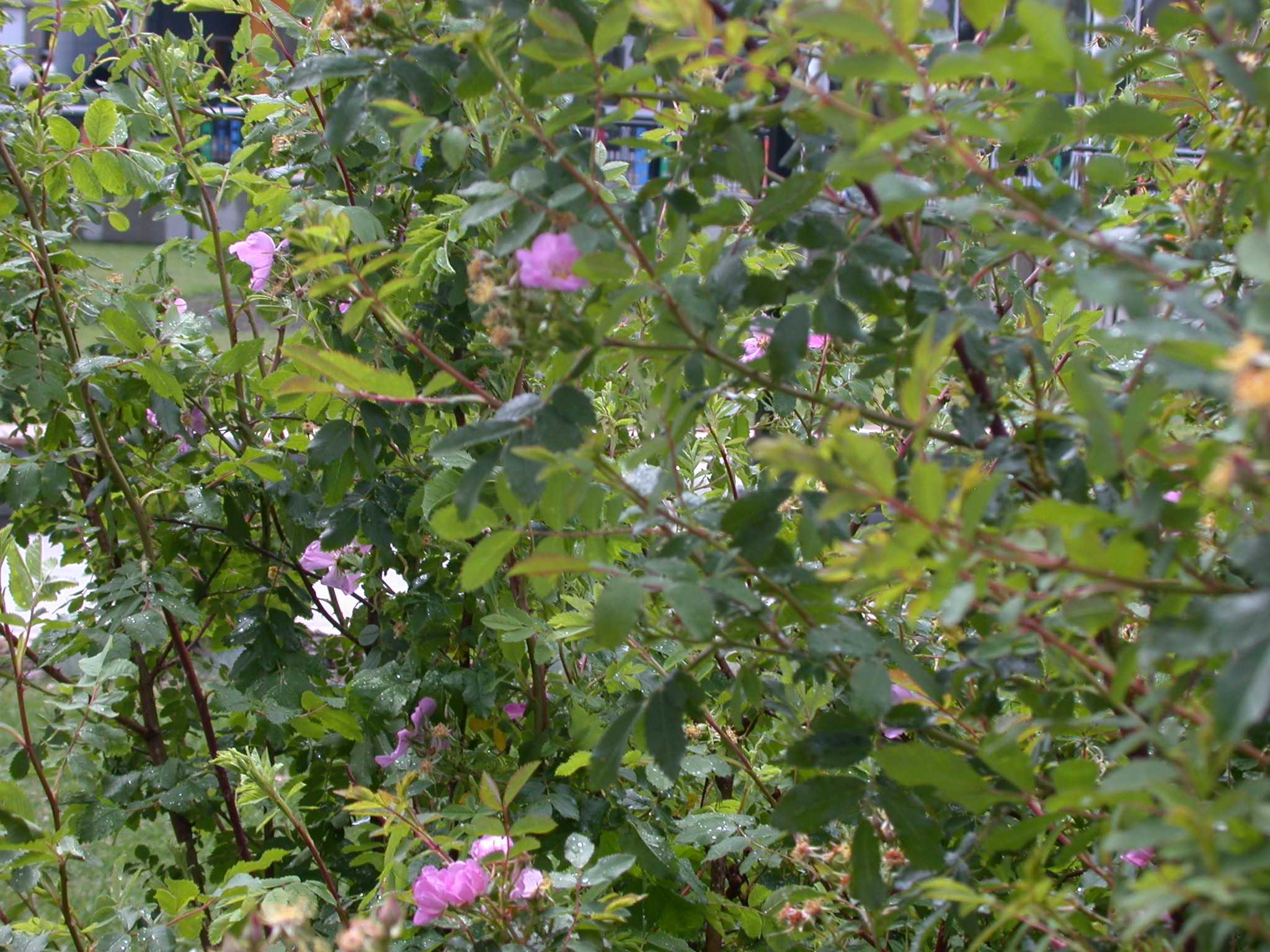
    Wild roses. June is the month of their blooming in our ditches, along margin lands, and road allowance. Flowers, wild, domesticated, and feral mixing and crossing in our parks, in our gardens. There is hope in the flowers: in many cities there is a reverting to indigenous plants.

    My earliest memory of summer is a garden. My Aunt Joyce’s farm garden (the closest thing to an English garden that I would see in my growing up) occupied a small yard behind the family’s squared-log house. To the five or six year old I was at the time, it seemed enormous, perfect for playing hide-and-seek, sheltered as it was by towering caragana and lilac, fragrant. A space laced with sun and shade, a raspberry patch in one corner and filled with the sound of bees. Peonies. Roses. Flowers we did not have at home, up against hedges and living room windows. I still remember the moment I came eye level with my aunt’s pink bleeding hearts. How they stopped me in my play with cousins. How perfectly they were shaped and coloured. I asked for their name. I spent a lot of time staring at them. I was spell bound.

    We grow up. We grow away.

    Those two weeks this May when smoke blanketed Edmonton, days when the air wasn’t safe to breathe, days when there was no horizon, I wrote this: “Even in this light, the children gather at the school grounds, play on the swings before going inside. The baby magpies call for their mothers, call to me like a mother, and the mating robin sings still.”

    There is hope in the young.

    Each day I wake up and I give thanks for the blue of sky and the green of trees I see outside my window. I give thanks. But I know that the smoke could return at any time. At least some of the fires are growing. Fire season lasts here well into October. As we celebrate National Indigenous Day in Canada, there has never been more of an urgency for reconciliation.

    Summer is fire and flower.

  • Spring Equinox 2019: Mud, Water and Light

    Every creation story I know starts with water and mud, spring no different. Slippery footing, sudden ponds, dirt in snow banks, grit in the street and a warm wind. The night freezes and the day thaws. For a couple of months it’s a see-saw, wild ride, back and forth, up and down the thermometer. It’s messy.

    Sometimes the messiness in our personal lives looks a lot like this: we take on too many commitments, our home suffers fire or flood, we have to have surgery, a relationship comes to an end, a loved one dies. One thing at a time or all at once. Our life looks like a disaster from which we think we’ll never recover, from which nothing will ever grow again. Our public lives too, when someone’s fear and rage chooses “the other” as target; when we reject the stranger among us, the “alien” within us.

    Have I ever been through a disastrous time? A rough patch? I was asked that recently. Oh, yes: Self-doubt, check. Discouraged, check. Worried sick, check. Falling, skidding on the seat of my pants, head first, head-over-heels. Yes, I’ve been and I’ve passed through as we, the living, all have, year after year, as we learn a little more each cycle of the seasons about what it means to be fully human, as we amass corage, as we gather heart.

    Every year for the past four years, a lantern parade has made its way through my Boyle Street neighbourhood.  It’s called GLOW. Every year there’s a different but connected theme. This year’s theme is Outer Space. Like the contours of spring, Boyle Street’s a tattered neighbourhood in places, a little rough and worn around the edges, but full of a youthful buoyancy. Boyle Street has a proud Chinese heritage and a strong arts presence in the Quarters Arts Society.

    Lantern festivals have their origins in Asia where, for example, they are traditionally associated with the Lunar New Year (in China) and with mid-Autumn harvest festival (in Japan). In the Netherlands, Germany and Austria lantern walks are associated with the feast of St. Martin, another harvest festival (Martinmas or Old All Hallow’s Eve, November 11th). In modern times artists are sparking a revisioning of lantern parades around the world: Lismore, Australia; Atlanta City, USA; Palmerston North, New Zealand; to name a few. The lanterns themselves are usually made from paper, fragile and fitting stuff for an ancient and a Green Age. But the act of processing, a community filling the streets with light to celebrate a season or a saint has been part of human history for millennia. There’s something infectious about a parade, especially one at night, with a warm (or cold) west wind blowing in your face and an emblem in your hand. And something infectious about a maintaining a tradition, no matter what’s going on in our very complicated and troubled 21st century lives, that celebrates the earth’s cycles and invites us to rebirth. We still need rituals, perhaps more than ever, that bring us together and remind us of our common humanity.

    Outer space invites me to think big, to look up, to see beyond what is known in my small world, to make me curious about aliens (other beings), the alien parts of me, the unexplored spaces in my psyche about the “other” and “outer spaces” within. Yes, if there are aliens then I am one too. Paradoxically, never more than when I am skinning my knees on a rough patch.

    This year, because of vacation plans, I will miss the Saturday parade. But you can join. Anyone can. Check it out: https://www.todocanada.ca/city/edmonton/event/glow-festival/ and hold up your lantern for all to see.


  • The Breath of Winter: Solstice Eve 2018

    Many years ago now, around this time of year, I came down with a bad case of bronchitis. My lungs were not the same afterwards. I was diagnosed with asthma. About 10 years ago, I started having more and more reactions to the medications. In 2009 I went for acupuncture. More than a year into treatment with Dr. Aung, on the first smoky day of the wildfire season, after standing outside for 20 minutes for a work function, I realized that I wasn’t wheezing like I normally would, I wasn’t having trouble breathing at all. I went for all the tests. There was no sign of the asthma. I threw away my inhalers. 

    Fast forward to November 2018. I caught a virus in mid-November, a bad cold that went to my chest and sat there, the way I used to feel when I had asthma. I would have to catch my breath while talking. I would sleep for 10 hours and feel in the morning as if I had slept for five. This went on for weeks. I couldn’t figure out why after so many years, it felt like the asthma had returned. “You just need rest and time,” the doctor kept saying. “Rest and time.”

    The very first time I saw Dr. Aung, there was still ice underfoot, but spring was on the air. I came out of the clinic afterwards, my whole body vibrating, shot through with bits of air and light. The street was awash with the drab pastels of that season, an amalgam of sensations and shapes: office towers angled overhead, the sky clouded, the bare trees and my scarf bending with the wind, the feel of a cracked sidewalk under my feet, all of it lifting me, threatening to carry me in its current. For the whole two blocks to my bus stop, cars were coming and going on the street, all around me people were passing, their voices hushed, but I felt connected to each one, reverent, the feeling of their day close to mine—excited, happy, sad, fearful—a swirl—everything speeding as we passed each other. It was like looking at the world through a kaleidoscope.

    When I went looking for that experience this week, the place where my journal fell open was about two months into my treatment. It was the record of a conversation with Dr. Aung.

    “Can I give you a hug?” he asked me.

    I took his hug and I said to him, “I don’t know why, but my asthma is really bad this week.”

    “Sometimes sadness does that to us.”

    “You’re right! That’s what it is!”

    I can tell by looking at you; I can see.”

    Sometimes it takes us a while to see what’s changed inside. There has been some sadness in my life of late. Losses, not with the permanence of death, but losses still, of trust, of surety, of innocence. Midwinter can be a difficult time. It’s why we gather our families and friends around us, why we feast and sing and tell stories of hope. Without sadness we wouldn’t have joy. Without darkness, light.

    I went twice to Dr. Aung this week for acupuncture and cupping. Both work on the theory of qi or ch’i, variously translated as the dynamic life force or flow of energy. It’s a concept not unlike the Hebrew concept of ruach, which means wind, breath, and spirit. To breathe is to live; to breathe is to pray. Both are true. The practice of qi gong is the practice of balancing energy. Blockages stop the flow. Our breath is what connects us to everything.

    Within hours of the first visit this week, my lungs had calmed. I slept the deepest sleep I had in a month. I’m recovering my breath and with it my spirits.

  • Fall Equinox 2018: The Stillpoint

    I walk to work every day, zig-zagging, cross-stepping as-the-crow-flies, in a beeline from my place in Boyle Street, on through downtown Edmonton. This year some of the route has changed as my own life has changed. Work has moved and my role with it; I have to walk a little farther than I used to. But there are stillpoints along the way. Vistas, soundscapes, and living creatures. Some are predictable, some surprise and then disappear. Those last I call angels. Stillpoints, all, because they stop me in my tracks, because they bring me out of my head and into the present moment.

    One of my favourites is a window at the corner of 105A Avenue and 93 Street, a window that beckons in early morning, spring, summer, fall or winter. A window whose season never ends flanked by a red steel door and a Manitoba Maple probably as old as the neighbourhood, thick at the trunk and gnarled; the leaves this time of year moving slowly from green to gold. The beckoning window looks east and is filled with plants: a spider plants, a prayer plant, plants I don’t even know the names of. Behind the window sits a filing cabinet, a book shelf, and a desk topped with piles of paper. In the next cavernous room, behind other windows and under high ceilings, men stand at work benches, hunched over machines. The green window follows me down the block, caught in my mind in a maze of brick and steel and grease.

    Many times in the six years I’ve walked the route, I’ve wondered who tends the plants. I’ve speculated. A woman obviously. I’m not sure why I would be so confident of that. A woman with her own office. A woman among a sea of men. The bookkeeper? Human Resources? The site nurse? A manager? I had never laid eyes on her. Until this week.

    Friday morning she was there, framed, red-haired, in the window, smiling, watering her green plants as outside the snow fell lightly to the ground. Thank you, I wanted to say, in a world so out of balance with time and with the material, a world filled with violence masquerading as truth, for continuing to pay attention to some of the simplest, the most real, processes of being.

  • Summer Solstice 2018: Consider the Lilies

    One rainy day a couple of weeks ago, I was standing at the corner of 100th Street and 102nd Avenue with the usual students, professionals (me included) and “people without place” waiting for the light to change. I had my big umbrella with me, the one I like to use for heavy rain because it will keep all of me, and everything for a few feet around, snug and dry for my long walk to work. As we waited, a young man playfully sidled up to me and popped his head alongside mine. “Hey, can I sneak under your umbrella for a minute? I hate getting wet.”

    I could smell the alcohol on his breath. But he had a great smile and I smiled in return. Who likes getting wet? Then his friend asked, “Can I come too?”

    The first thing out of my mouth? “Well, I can’t fit everyone under here!”

    Isn’t that the reaction we’re seeing played out across the globe and close to home right now? The fear of scarcity. A very human reaction.

    “Sure you can,” my new friend assured me. “Okay,” I said. “All right,” my feelings suddenly a strange mix of sheepishness and elation. We crossed the street that way, chatty, fast friends, the three of us under a common turtle’s back for a few precious moments.

    German Sociologist Aladin El-Mafalaani points out that we live in one of the most conflicted times in human history and, paradoxically, in a time of unprecedented social progress. The flashpoint for this conflict is the migrant, whether the migrant from our own backyards or the one we see adrift on our television screens every night, because he/she represents the intersection of our society’s inner and outer struggle with openness. El-Mafalaani argues that before every major social change—the rise of democracy, civil rights, human rights, women’s rights, protections for ethnic and religious minorities or people with disabilities–there is pushback. “Conflict is energy.” Conflict gives rise to innovation. “Without conflict, there is no social progress.” It’s how we deal with it. Something I’ve been thinking a lot about lately: contemplation. And something very like I heard from one of the speakers at the first Women’s March here in January 2017, “Reach out to someone you strongly disagree with. Engage in a dialogue. Listen to their point of view.”

    “Where are you headed this morning,” I asked my young friend? He hesitated for a minute, still smiling. “I think City Centre. Maybe I’ll get a cigarette. I don’t know. I like to wing it; that’s just how I am.”

    I thought about the Eastern Orthodox tradition of holy fools. Often homeless, always poor, appearing insane and even intoxicated, deliberate “fools for God.” Maybe my young friends are a modern version of that joyously-in-your-face protest of the world or the product of a deep history of societal pain or both. Either way, like the wildflowers and the grass of the field all around us this time of the year that neither toil nor spin, yet are gloriously arrayed (Matthew 6:28), they call out to be noticed.

  • Spring Equinox 2018: Here for good

    Recently someone new to Alberta asked me, “When does the snow stop?” really meaning to ask, “When does spring come?”

    “It comes and it goes,” I replied. “And then suddenly it’s here for good.”

    My mom left a message on my phone a couple of weeks ago: “It’s running out there! You can hear the water. It’s running down the drains. It won’t be long now. Just a few more warm days.”

    The seesaw of melt and ice.

    Spring, like all seasons, is a transition state. Spring reminds us that there is growth in every season of our lives. Like all transition states, beginnings require careful navigation. It’s slippery. We’re not always sure of our footing.

    Early in February I celebrated Brighid’s Day, what’s sometimes called the Celtic spring, with about 20 other women. We took turns passing through Brighid’s crios. Brighid’s girdle was once a hoop made from the old year’s harvest straw; our girdle was made of strips of cloth found at Fabricland. Three times we passed through the crios. Circling left and then right and then left again and through. First to leave behind all that was ill, then to give thanks for all gifts of the year past and then to pray for new growth.

    We entered the womb of Brighid to be reborn.

    This spring I am conscious of new relationships emerging, not only in my personal life but in my community. I’m not always sure of my voice in these relationships and often feel as if I am taking two steps forward and one step back.

    In a close personal relationship I am exploring, there is a testing in the dialogue as we come to know each other’s edges and strengths, as we talk about what is really important to each of us, as we come to see our own vulnerabilities in the mirror of the relationship.

    In the same way, I’ve been witness this past year to an emerging dialogue in Canada between Indigenous and non-Indigenous peoples, at work, in public gatherings, in the media and amongst friends. For me, the talking and the listening is cause for hope.

    So it was serendipitous this past February that I got to visit New Zealand with this person I am exploring a partnership with, a Pakeha, a person of European or non-Maori ancestry, who grew up there. That I had the opportunity to witness a different sort of relationship between settlers and Indigenous peoples than one I am used to, a partnership grounded in mutual respect.

    Maoris were granted the same rights and duties as a British citizen with the Treaty of Waitangi (1840) as well as control of traditional lands. Like Canada, the treaty wasn’t always observed. Rights were trampled. Lands taken. Residential schools were imposed. The social effects of this are still evident to some extent. But the Maori have always been represented in parliament; the Maori have always had the vote. Their land claims process has largely been a fruitful one. They communally administer their lands; they also individually own sheep stations and tourist resorts, live on “lifestyle blocks” (acreages), and in villages and cities where they work alongside everyone else. Most of the towns have Maori names and many of the streets. This is a country whose educational curriculum is written in two official languages and incorporates not only Western content, but Maori principles. The consciousness is different.

    Like an Alberta spring, justice may come and go, but I do believe one of these days it will be here for good. If we keep at the dialogue.

  • Winter Solstice 2017: Darkness and Light

    The last few years I’ve gotten into the habit of putting out photographs in my living room of those near me who have died during the year. Their faces greet me each day as I go about my morning yoga; they smile at me every evening on my return from work. I leave them out for family celebrations, visits from friends, and condominium board meetings. Each is an object lesson, a saint of sorts, a model in living. I contemplate them and then, eventually, I let them go.

    Archeologists say that the oldest human rituals revolve around death. They provide a vessel for transition and grief; they demarcate the boundaries of the living and the dead, this world and the other world. Christmas is a particularly hard season for anyone who is bereaved.

    This year there are two portraits on my mantle: one of an aunt who was a traveller and a reader, who lived on the family farm into her nineties and whose curiosity about the world I admired; the other of a woman half her age, a co-worker of mine, also an independent thinker, a brilliant visionary, who struggled with self-acceptance and, in the end, took her own life. Both are a witness to me; both are teachers. As with all human beings, both carried struggle and joy in their journey, darkness and light.

    In their origin, Christmas carols were part of the people’s rites, going from house to house and singing in exchange for treats; they were not part of the official religious observance. Many are stories of peace and conflict, gift and loss: the contradictions of life held in tension. At the centre of most Christmas music is the image of the holy family and I would argue all families. There is birth but there is also a foreshadowing of suffering, the suffering that comes with growing in this world. The parents have such hopes. The innocent babe becomes a child, becomes an adult. Makes choices, learns or does not learn what is needed to love, suffers, and sometimes dies too young.

    I have come to think that this is the meaning of the holy: the blood, the bone, the breath, the unique story that binds each of us to the soul of the world. All of it, Mystery.

  • Fall Equinox 2017: Music and Prophecies

    I have an image of my child self that I often call to mind. I am probably 10 or 11 years old; it is the 1960s. I am sitting between our family kitchen and living room, my back against the door jamb, my knees pulled up in front of me, listening to the radio that used to live on a shelf underneath the kitchen counter. From where I sit I can see south through the kitchen window to the bush that surrounds our house. Beyond it, I know the fields roll half a mile to our neighbours. If I look east past the kitchen through the porch wall full of coats and the floor mats full of boots, through the back window I can see the barnyard, the cows, the dog, chickens scattered here and there. If I look west I can see the horizon beyond the picture window and the sky. The radio is on: news, music. Wonderful music. The Beatles. Peter, Paul and Mary. Elvis. Simon and Garfunkel. Bob Dylan. Every newscast, an explosion. The radio is the world to me then. I hear the news of riots, cars turned over, cities on fire, police with shields, shop windows smashed. Brutality. Protests, people standing their ground, speaking up. Defiant lyrics. The speeches of civil rights leaders and presidents. People fighting in the streets. Talk of pollution and acid rain. Threats of nuclear war, which my young self cannot fathom. And through it all, song. The adults hold a certain tension in their listening, in their talk. But there’s also an excitement undergirding it all. I feel electrified listening to this troubled, strange, mysterious world. I see the possibility of making things new, conscious that I, myself, am part of the new. I sing along.

    I think about those times now when I listen to the radio, which I still do. The news over breakfast and supper, and the music which I hum along to when I can. But I am also the adult now, and I feel the anxiety that is weighing on the planet. The war talk and hate speech that I hear reported daily. The rhetoric and cheap sentimentality that passes as public policy. Even the weather is ominous. The smoke that has drifted our way all summer, from fires the scientists now assign a new category, past extreme, to catastrophic. Forest fires that even snow and sub-zero temperatures can’t put out. It is only the beginning of the hurricane season in the Atlantic and already we’ve had two once-in-a-hundred-year storms in quick succession: Harvey, Irma, and a close contender for the title, Maria. Whole nations are devastated.

    Maybe that is why I felt an urgency this fall to get back to my community choir practice. Why, even though I have more commitments in my life than ever, I show up and sit in my chair among the second sopranos. Why I mark the music and listen to all the parts, low to high, and sing along for two hours every Monday night. To be one with the human voice, to carry within me those strains of hope and defiance. By the second week of practice, I am going to bed again to the music in my head: Mendelssohn, Bach, Vivaldi, fragments of choruses in languages I don’t understand, from other centuries and this one. Voices to dream by.

    And so it dawns on me what I was doing as a 10-year-old, how powerful the human voice is in the cultivation of consciousness. Music, to lift the heart for the waking work for justice.

  • Summer 2017: Healing Leaves 150

    And the leaves of the tree were for the healing of the nations. Rev. 22:2

    A few weeks ago on a CBC Ideas podcast, How Art Shapes History, the moderator asked a panel of artists: What makes a nation? Christi Belcourt, a Michif (Métis) visual artist, pointed out that this land we call Canada is made of many, perhaps thousands of nations; that the surviving indigenous nations alone in this country number more than fifty; the bison, all manner of animals, plants, animate and inanimate beings are themselves nations. When she said “We consider the trees to be nations” something stirred in me.

    My father loved forests. If he had had his way, we would likely have grown up in the bush in a lumber camp and not on a farm. As it was, we grew up alongside remnants of boreal forest. And we still have a quarter section in the family that is “virgin” boreal forest. It has never been farmed or clear cut. My father was a logger for a good part of his young life and still dabbled with timber when we needed wood to build houses or barns. Yet he and my mother likely planted more trees than they ever harvested. The fascination with and respect for forest has remained in the family. One of my nephews is named Sawyer in my father’s memory. My younger brother still spends many weekends at the “Stump Ranch,” culling old trees for firewood. My older brother goes on tree planting sprees.

    The trees are nations. I think at an unconscious level, we have always known the bigger interdependence we are part of. I notice when things change; I bet you notice things too.

    A row of eight mature green ash trees used to live in front of the Edmonton Police Service (EPS) Station Number One. I walked by them every day. They were pollarded last year. “Topped” is the word that professional pruners use. Topping is an extreme practice and works well if done right. Locally, I have seen laurel willows pollarded, with mixed results. There were sycamores that I knew in Berkeley (and the ruby-throated hummingbirds that fed on them) that were pollarded. They transformed the space in front of the grand columned university library into a Roman square. But like most pruning, it has to be done at the right time. The contractors who did the topping at the EPS Station Number One, during what was one of our earliest and warmest springs in many years, waved away my concern when I stopped to question them; said, Oh, these are going to look great in a few weeks. You just wait.

    I did wait. A few new branches with fresh leaves sprouted out of some of the limbs, but most stood shriven for the rest of the season. Earlier this spring, I noticed that they had been completely removed, their stumps ground, a bit of sawdust on the ground, all that was left. When I phoned the City, I found out the trees had not recovered from the topping. To the credit of EPS and the City, the trees have been replaced and their stewardship taken over by the City’s urban forestry department.

    It was a great loss. Those ash trees were likely planted at the same time that the station was built in 1982. That would make them 35 years old. Thirty-five years of rain and drought, thirty-five years of freeze and thaw, thirty-five years of growth towards the sun. Mature ash live an average of 120 years. Some have been known to live 175 years. Elm, green ash, black ash, oak and maple. You can see all of them on streets in our older neighbourhoods. Their nations go back eons; “ancient” doesn’t describe it. Even planted, they’ve managed, I’ve noticed, to create an intricate web of life in their shade. No wonder they can outlive us.

    As Canada comes up to marking 150 years as a nation, I want to ask the trees and all the other nations we share this place with, What can you teach us about living together? About justice, about memory, about change? I want to take stock of how we’ve lived with difference and how we might live in new ways with difference going forward. I want to listen.

    That is my prayer.

  • The Hope of Spring 2017

    Coming home on the bus in the middle of February, deep in the last cold snap of winter, I sat beside an elderly woman who swore she could smell the Athabasca Glacier, all the way from the Columbia Icefields. She could smell it on the west wind, that very day. She had been there once. She knew.

    “What does it smell like?” I asked, curious and more than a little skeptical. “Like rotting garbage?” (Thinking of all that debris.)

    “Oh no,” she said, “so fresh! Think of the water molecules released that haven’t been breathed in ten thousand years! The pure air, just lying there, never touched!”

    When I got off the bus that night, I admit, I tried to sniff the air a little against the minus twenty-nine degree wind. It didn’t last long. I pulled down my hat and covered my face with my scarf and bee-lined it for my apartment and my fireplace.

    But I haven’t stopped thinking about her words. They touched something in me: the dream of life stacked layer upon layer. The layers of story under our feet. The generations that have gone before us, their genes and their experiences, my own life experiences. Some of them like an ice sheet, some like an Arctic or a Pacific Ocean. Some like a volcano or an earthquake. How they’ve all shaped who I am today. The parts buried and exposed; the parts that still await discovery.

    The change of seasons reminds me of that promise, spring perhaps more than any other. Every spring is a piece of the spring gone before and a piece yet to come. The layers speak of a new generation. The freshness in the air, something not thought of or felt in months or years. The earth remembers itself, unfurls ancient molecules—soil, air, water–seed. Hope.

    Saturday night in the Quarters near where I live, the community gathered for Glow, a lantern parade on the Armature to welcome spring. The theme was Under a Prehistoric Sea. The land of what we now call Alberta was, more than once, covered by oceans. The bobbing lanterns in the crowd attested to that: jelly fish, star fish, giant turtles, prehistoric sturgeon. And there was a strong wind blowing, cold, just possibly, I thought afterwards, off a glacier.

  • Midwinter Passage 2016

    Some mornings on my walk to work, if the traffic lights are right, I take a shortcut through the Quarters up The Armature pedestrian mall. When I cross over 103A Avenue at 96th Street, I pass two bronze figures on either side of the mall, I sometimes call The Coyote Men.+ You might call them Sitting Man and Standing Man, Tricksters by any other name. They form a kind of gate to the neighbourhood. In place of their heads and hands, the heads and hands of deer, baby black bear, mother grizzly, turtle, squirrel, chipmunk, raccoon, blue jay, wolf, coyote, fox, hare–I’ve lost count–pop out of collar and sleeve.

    It’s like crossing a threshold to pass them or maybe a gauntlet, and I always make a prayer in touch, glance, or word. Some people leave offerings. I have witnessed a matching bronze boot stuck on one of Standing Man’s small heads, a lacy blue tunic pulled over Sitting Man’s torso, and on another day, a red blanket draped over his shoulders. The Coyote Men offer a preparation for the real tricksters about to come into my day, most of them sitting behind a desk, in a shop, or on a television screen.

    At Midwinter Solstice we cross a threshold too. Its coming marks the mid-point of winter, the division between the old year and the new, the longest night and the shortest day. It’s a hard season for for anyone living with loss. Christmas has so much riding on it, impossible hopes sometimes: the vision of a holy child, a holy mother, a holy family. My disasters this past year have been minor: a burst pipe, a break-in, and a couple of small repairs and rehabilitations to the aging body. Real disaster is this: debilitating illness, violence, and war.

    Whenever we move forward it becomes a question of faith. Will we leave offerings? Will we be protected? Will we pass through? We don’t know what the future holds, only the concreteness of this present moment. There are echoes of this in the vows families, friends and even communities make to each other, sometimes spoken, often silent: for better, for worse, for richer, for poorer, in sickness and in health. We move forward.

    I leave you with an ancient hymn arranged by the contemporary composer, Paul Mealor, whose music it seems to me comes from nowhere and everywhere at the same time. Music that is a trickster in its own way, pressing so many facets of the world into my heart: Ubi caritas et amor, Deus ibi est. Where kindness and love are, there is God. Or Spirit. Or Wisdom.

    +Brandon Vickerd, Wildlife (2015)

  • Fall Equinox 2016

    Enjoy the trees blowing in the wind while reading a book on the couch, my favorite thing.

    Those were the parting words of the owner who last lived in my condo. I too enjoy the sound of the leaves in the wind. I notice them more in the fall, maybe because the leaves are crisper or maybe because there’s more wind. I’ve set my reading couch to look right out the window of my writing room, right into the eye of the trees. Our courtyard is full of them. As I write this, I’m listening.

    Summers I like to read: classical literature or philosophy; I alternate. This summer I read Heraclitus, a kind of Ecclesiastes of the fifth century Greek world, a philosopher, literally a “lover of wisdom,” but a century or two ahead of Socrates, Plato and Ecclesiastes. Scholars credit Heraclitus with the notion of Logos (or Word) in Western thought.

    By cosmic rule,
    as day yields night,
    so winter summer,
    war peace, plenty famine.
    All things change.

    Fragments+ is a thin book really, called that because all we have left of Heraclitus are other people’s quotes of his writings. As a book it’s more poetry than prose, more contemporary than ancient, or perhaps it is the times we are living through that are ancient.

    But Heraclitus is not done with us. There’s something else to this fragment, one of the longer ones we have received from him. He makes reference to the closeness of death; close, too, during this season:

    Fire penetrates the lump
    of myrrh, until the joining
    bodies die and rise again
    in smoke called incense.

    I recall one of my professors once saying that you could translate the opening words to the Gospel of John, “In the beginning was the Verb” instead of “the Word.” Logos is a motion, a process, all of it energy, what Heraclitus named fire. “All things change.” Somehow in the change is the Mystery.

    +Heraclitus, Fragments, translated by Brooks Haxton, Penguin Books: Toronto.

  • Midsummer’s Eve 2016

    DSCN5504

    On my route along 92nd street, past the Mother Teresa School, under the elm clad arches of 104th Avenue, along the wild gardens of Boyle Street plaza, the sunken hidden garden by the courthouse, through the piazza fronting city hall. Past the robin’s urgent mating yodel, the see-sawed whistle of the house finch, the white-throated sparrow’s O Canada Canada Canada, the chickadees Summer’s coming summer’s coming, the yellow warblers sweet sweet shredded wheat. Past all these, the calls, the hurry, the frenzy of spring have calmed to a steady hum, a conversation of clicks and clacks, of clucks, murmurs, or a simple chirp. Even the humans have quieted, the traffic thinned in the downtown core. This is the conversation of summer.

    Lately I’ve been purposely stopping to listen to the quiet, to feel the warmth of the wind in my hair, to look at the wild roses blooming in the city on my way to work. (Have you noticed how pink the blossoms are when they first come out?) I go into the office buoyed by these small glimpses of joy, more generous-hearted, more at peace with whatever the day might throw me. I try in small ways to keep stopping and feeling. To look up from my computer screen and out my window for twenty seconds at a time. (Because it’s good for your eyes too.) But it’s hard to look at one thing for twenty seconds without wanting to fill the mind with some thought, something I must remember, some sentence I should write down, some phone call I should make. And when I get home, it’s sometimes hard to sit on my lovely new patio and simply look at the green, green courtyard and hear the wind in the poplars without reading or writing or rushing off to my next commitment. It’s sometimes hard to just be in my breath and breathe and breathe until the enough becomes clear. Yet, I’m convinced this is how the well of love is fed and so I keep trying and will keep trying to practice this open-heartedness to beauty that opens up my life.

    About a week ago the daughter of an old friend of mine died of cancer. Joanna was 33 years old, smart, passionate, and full of life. A small tumour on her tongue eventually took over her body. From diagnosis to death was less than a year. She was just coming into the summer of her life, but in many ways it seems she was wise beyond her years. After the celebration of her passing on Saturday, I came away with this: the challenge is love. For Joanna that meant a constant curiosity about the world around her and the world inside her. She was always listening.

  • Spring Equinox 2016

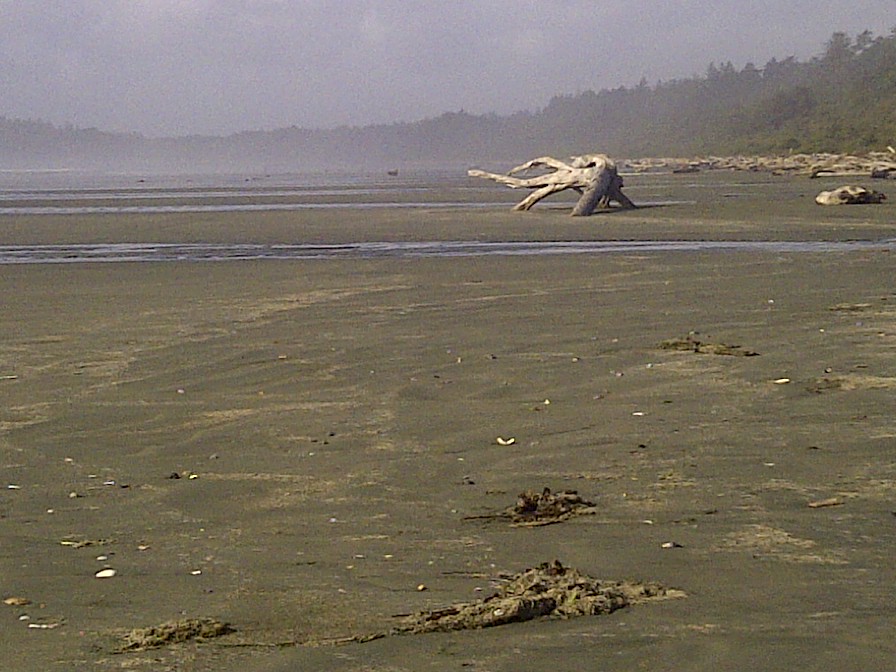
    Long Beach, Vancouver Island
    Long Beach, Vancouver Island
    January 23rd I came home from my usual Saturday morning run to the Downtown Farmer’s Market to commotion in the front lobby of my condo complex. Water was ankle deep on the main floor; someone was trying to find the key to the utility room so that we could turn the water off. We didn’t know where it was coming from. I joined the search. Ten minutes and a whole lot of damage later, we found the burst pipe. I walked into my own unit hoping that it had escaped somehow, but the water was in my master bedroom and my living room, coming up in the carpets and the walls.

    If you know me, you know that I thrive on structure, routine, and order. Water washes all of that away. The walls in my bedroom had to be torn open, the living room and bedroom furniture piled and covered, the baseboards torn off. My office has also become my sleeping quarters, dining room, and living room all in one. I often eat while I read my email. Somehow between my bed and a narrow shelf I’ve managed to squeeze a yoga mat. In one corner, about four feet by three, I’ve laid down cushions, a prayer rug and a stack of books, and this is where I read every night before I go to bed.

    This room reflects a distillation of the things that are really important to me. It’s a bit like living a monk’s life, except that I’m still very much in the world: I work and go out and go about my business. Of course, some days it’s an annoyance when I get up too quickly from reading and knock my head on the computer tray that I’ve left sticking out. There’s no good place to put my clock (there’s no room for a night table), so some mornings I have slept through the alarm. And I can’t get used to walking through the bedroom to my closet every morning past all the remnants of the destruction. But the months before this happened, and accelerated since the flood, I’d been working to make more space in my life, to live more spontaneously, more fluidly. It was the reason why I spent a week in February on the Pacific Rim walking the beaches and watching the storms. Why I’ve been accepting more invitations for coffee, for supper, and invitations to share my writing. I wonder some days what this might be preparation for, this opening? Retirement? That’s still several years off. Loss? A new relationship? Aging? New writing projects? Somehow it connects to a desire for balance.

    Tonight I took part in the neighbourhood Earth Hour celebration at Boyle Street Plaza: Glow. As we paraded our paper lanterns down 96th Street in the dark, I felt a strong sense of optimism about the new spring coming towards us, and looking out over the river valley, about the mix of both shadow and light in our city, our world, and our universe.