Category: Reflections

  • Spring Equinox 2025: Imagine Equal

    The word equinox comes from the Latin for “equal night.” It’s the point when the sun crosses the earth’s equator. In the northern hemisphere at this time of year, we celebrate the vernal or spring equinox; while the southern half of the world celebrates the autumnal equinox. On equinox, night and day are roughly equal all over the planet. Twelve hours of darkness, twelve hours of light. Another way of describing this: equinox is the only time when the northern and southern hemispheres are equally illuminated.

    A moment of illumination; a moment of balance. What does equinox (north and south) have to teach us at this time in the earth’s story?

    When I used to lead spirituality workshops, I would often start with a meditation called Flame of Love, probably an adaptation of a Buddhist practice. It begins where one is, in one’s body and one’s surroundings: a room, a backyard, a lake. And gradually moves the heart outward in a spiral across city lights or rural skies dark with stars; one’s region and landforms, rivers and lakes; one’s country, across borders, then multiple countries; over continent and continents, oceans, and finally the whole earth held within one’s mind. Sometimes I would simply play a short NFB video called Cosmic Zoom that does the same thing starting from the cells of the body and “zooming” out to the universe and back again.

    It is worth pausing to consider on this day the equal light and darkness that falls on the whole earth, our enemies and our friends, familiars and strangers alike, the light a gift to us all. On all the suffering places of the world: Palestine and Israel, Russia and Ukraine, Somalia, the Congo, South Sudan, Haiti. On the peoples of Syria, Myanmar (Rohingya) and so many others forced from home to wherever they find themselves including those camped on the highstreets and byways of our own cities.

    We each stand equal on this day in the gift of day and night. No one more or less. No one controls the sun in this universe. There are no borders on it.

    Maybe if we stand in that insight/in this moment, we can remember who we are. Remember our suffering land, what Robin Wall Kimmerer calls the “more than human world.” Imagine the forests rising up, the oceans, inland lakes, the mountain ranges, prairie, steppe, and deserts. Imagine the wind. Imagine the volcanoes, earthquakes, clouds and storms, tornados and cyclones, so much more powerful than the voices of might and chaos ascendent in our human world right now (voices within us and those surrounding us). Maybe we can imagine equal.

  • Winter Solstice 2024: The Sacred Tree

    Winter Solstice 2024: The Sacred Tree

    A Manitoba maple on what would have been the southwestern border of River Lot 20. December 20, 2024.
    A Manitoba maple on the southwestern border of what would have been River Lot 20, Edmonton, Alberta. Dec 20, 2024.

    Trees have always been part of our family. My father was a sawyer as well as a farmer. My mother grew up on the “Dust Bowl” prairies of the 1930s and for all her adult life planted and nurtured trees wherever she could. We still have a “quarter section” of boreal forest in the family. Though as a child I often tired of tree duties—watering, weeding, hoeing, not to mention filling the wood box for our stove (my daily chore at four years old)—trees are in my blood.

    Trees are considered holy in many cultures: rowan (Irish), oak (English), spruce (German), cedar (Coast Salish), ceiba (Mayan), bodhi (Buddhist), and kauri (M?ori), to name a few. Many outlive people, provide layers of habitat to birds, small and large animals. Provide shade, shelter and fruit to humans. Provide medicines. We still see the survivals of this reverence in the Western traditions of the Maypole and the Christmas evergreen. The Christian church tried to replicate the heights and majesty of ancient old growth forests in its European medieval cathedrals. The same feeling, I propose, that city planners and architects today attempt to reconstruct with skyscrapers.

    When I walk along the North Saskatchewan River kisiskâciwani-sîpiy or “swift-flowing river” in nêhiyawêwin (Cree); Omaka-ty or “the big river” in Niitsitapi (Blackfoot), I am always listening and watching for other creatures: the chickadees, woodpeckers, and nuthatches; the wind; the coyotes, hares, and squirrels; the grasses, the light; the bees, mosquitos, and butterflies; the bushes, the trees, the water; among others.  I ponder. Perhaps that’s how I started thinking about the Manitoba maple (acer negundo) growing all along the river edge in Dawson Park (which crosses over the old River Lot 20 where I live today.) Their pretty winged seed pods, pink-edged in fall, tan in winter. Their gnarly trunks and wizardly branches. Manitoba Maples are drought and flood tolerant, adaptable to any soil, form clumps (read: grow in community), have a tendency to find their footing on riverbanks and floodplains. Manitoba Maples have an average lifespan of 60 years, but it seems that some well exceed that. How did they get here? They’re not native.

    The notes on the 1882 survey of the Edmonton Settlement list four types of vegetation starting from the river flats to the heights: “prairie,” “brush,” “swamp” and “poplar timber.” That’s pretty much the description both sides of the river in all directions, with minor changes to the order. Good habitat for beaver, aka Beaver Hills House or amiskwacîwâskahikan (one of Edmonton’s earliest names). Also good habitat for Indigenous peoples for whom the prairie fed bison; brush and swamp meant berries, medicines, large and small game. We also know before settlement that Indigenous peoples practiced cultural burns to renew and replenish the land for these creatures.

    I have a theory that the Manitoba Maple were introduced by the Métis and others with a connection to the original Red River Settlement. And even though eye witness accounts say that the forests were practically gone from the Red River Valley by the 1870s, paintings and photographs from that time still show the odd shade tree in yards. What kind is not clear. But fossil records for the same period show that the Métis people still burned local Manitoba maples in their fireplaces at least some of the time. I wonder if the Métis chose the Manitoba maple as a testament to their survival and resilience? Both as a memory and a dream: a place they once loved, a place that held a vision of a different kind of Canada and the experience of a different kind of community?

    Métis Laurent Garneau migrated to Edmonton from St. Andrews Parish on the Red River and planted a single Manitoba maple behind his house on River Lot 7 on the southside of the river in 1874, where it presided until 2017. Richard Charles Hardisty, Chief Factor of the Hudson’s Bay Company, first Métis Senator and advocate for Métis rights, planted a circle of maples around his garden at 106 Street and 97 Avenue in 1875, just outside the walls of Fort Edmonton. Mr. Hardisty grew up in the Red River Settlement. In 1906 David Latta planted the same tree on a corner of his riverside property at Jasper Avenue and 90th Street within the old confines of River Lot 20. Here he built a new house for his second wife, a Métis woman named Emily Decoteau, whose father fought in the Riel Resistance. Other settlers planted them too, but these were some of the earliest.

    These days the kisiskâciwani-sîpiy valley near where I live is a cacophony of flora from many other places and even continents, very much reflecting the people who live here. Domestic gardens and fields run feral, including the Manitoba maple: pine, mountain ash (rowan), green and black ash, elm, oak, false holly, lilac, caragana, goji berry from the Himalayas, buckthorn, Canada thistle, and burdock, grow alongside their native fellows: poplar, trembling aspen, birch, spruce, chokecherry, cranberry, gooseberry, saskatoon, wild rose, red willow, sage, wild onion, yarrow, and wild grasses. Their multiplicity, a lesson in human relations. To quote a Beaver Bundle carrier, Ryan First Diver, we are here to learn from plants and animals so we can mature as a species. Some dominate and destroy. Others work alongside their fellows. Together they’re holding this space for us. And this light.

  • Fall Equinox 2024: The Depth of Time

    I wonder sometimes at the dimensions of time. Seasonal like this Equinox and tied to movements of the universe. Linear or cyclical and tied to human history, the decisions and actions of individuals and communities. Or even the way we think of our personal age or lifetime, as in “length of time.But I think there’s another kind of time we might call thin or packed full, apparently random, where a split second can change everything in a life: ­­direction, plans, capabilities. Yes, there is shock, anger, and discouragement at times. But in this kind of time there are also moments I call grace, though someone else may call them fate and maybe they are both.

    Six weeks ago I was struck by a vehicle while riding my bicycle to the downtown farmer’s market. I am walking and talking, but it’s put me in the slow lane temporarily—slow of moving and slow of thinking. I find myself looking in on human goings-on as a semi-outsider. Watching and listening to the daily rush of life from the sidelines. Somehow I see and hear more in this state. Some of it comforting and some of it disturbing. Let me tell you about the comfort.

    The week after I was hit I saw our building janitor, Sahwa; I was on my way to a doctor’s appointment. After I told her what had happened she said to me, “You weren’t killed? How come you weren’t killed?” She thought for a moment. “In my culture we would give a big donation,” she said. “Give a big donation to something! That’s what I would do.” Her words stayed with me. Later that day, I came home and made some donations. Her name I would come to learn means, Angel, in Arabic.

    That first week too I attended a memorial for sexually exploited women in Edmonton. It’s something I try to do every year for women who go missing, are murdered or die prematurely because of their time in the sex industry. The organizers were handing out tobacco ties: loose tobacco tied up in little red pouches, an Indigenous tradition. “What do you do with them?” I asked? “Make an offering to the earth. It’s a way to give thanks. To pray.” I took one. I knew right away what I wanted to do. As soon as I could walk as far as my favourite lookout on the river, I shook the medicine free and gave thanks for the healing that had brought me there.

    A couple of weeks ago now, I was renewing my membership at the art gallery and an old workmate hailed me. He’s on long-term disability leave he told me. He had had a brain tumor. He showed me the crescent shaped scar on his scalp where they went in. He didn’t know if he would be able to return to work. What he was focusing on instead, he said, were people. People. People. He said it three times. I took that to mean relationships. We took some selfies together. He gave me pause: what am I focusing on at this time?

    Last week I met with a friend whose cancer has metastasized. When I asked her how she is, she was straightforward. “It’s progressing. But it’s okay. As I said to my husband, I can do everything I want to.” And that floored me. Can I do everything I want to? Maybe not in my current physical and mental state, but when I’m healthy, am I doing everything I want to? And even now, am I being everything I can? Am I choosing fully?

    My final revelation. I take little walks, a few times a day to gain strength. I was strolling by the St. Teresa of Calcutta school in my neighbourhood this week. The sign outside read, “With children comes hope.” I live in a very diverse neighbourhood. Children of every creed (Buddhist, Muslim and Christian), ethnicity, racial background. The students were on their lunch hour and they were in every corner playing. The older kids helping the younger ones on the swings, the boys and girls playing soccer together, football and basketball. Everyone getting along, having such raucous joy. Hope.

    And so these are my humble offerings to you this fall equinox, these messengers and messages, a small lesson on the depth of time.

  • Summer Solstice 2024: Land Acknowledgement

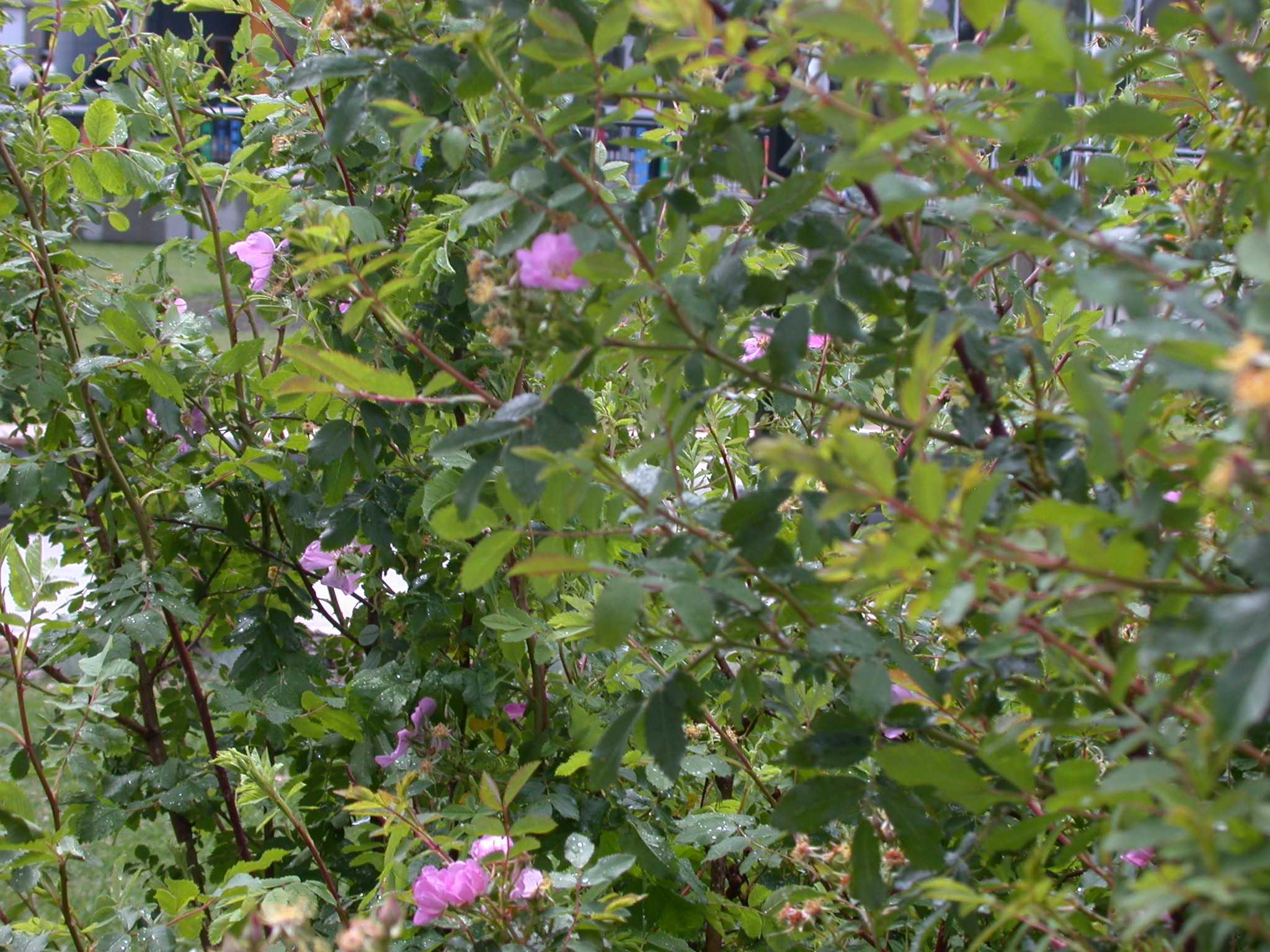
    Wild rose in mixed and poplar woods, Dawson Park, Edmonton, June 2024.

    Friends and taxi drivers are always getting lost trying to find my address in Edmonton. In Boyle Street, the streets and avenues seem squished together; there are no straight lines. I used to blame it on the bend in the river. Turns out, it goes much deeper than that. As we approach this National Indigenous Peoples Day in Canada, I want to offer a partial archeology of this place, a kind of cross-section from the archives. There are so many layers, so many Indigenous Peoples, so much wildlife, so much loss. But this Summer Solstice I want to focus on those times and people in-between the First Nations and the European settlers: the Métis and their footprints on this land. Specifically this small patch of ground beneath my feet, River Lot 20.

    One thing about the pandemic is how it washed all our structures away, stripped us back to the essential relationships: family, home, immediate community and land. Allowed us to imagine a different present, a different future. To imagine not some kind of dreamy ideal but to know that things weren’t always like they are now and may not be tomorrow either.

    At one time (1906-1920) there was a federal penitentiary on the very spot of ground where I now live (p. 26) and just south of that along the river’s edge was a coal mine that the inmates had to work. Further south and earlier yet (1893), Mr. J. B. Little started his successful brick yard on the flats of the valley (Riverdale). But before any of this and the reason for all the angles in my neighbourhood has to do with the river lot system.

    The surveyor maps of 1882 show there were already forty-four river lots on the North Saskatchewan either side of Fort Edmonton; even numbers on the north side and odd numbers on the south. The lots on the south side ended at what is now University Avenue. The lots on the north (a mile long) ended at Rat Creek or 118th Avenue.

    There were river lots all over Alberta before settlement and after the Métis practice at the Red River Settlement (inherited from the French practice in Quebec). River lot settlements thrived for decades along the southern rim of Beaverhills Lake, at Laboucan on the Battle River Crossing, further up the North Saskatchewan near Smoky Lake (now Métis Crossing), out at St. Albert along the Sturgeon River and around Lac Ste. Anne to name a few. Several families moved west after the 1870s after the failed struggle for a Métis homeland in Manitoba. And while many of the names on the Edmonton river lots sound Scottish, the men often married Métis women or were of mixed Indigenous and European heritage themselves. Here is a just sampling.  

    In 1860 two brothers-in-law, James Rowland and Kenneth McDonald staked (respectively) River Lot 18 and River Lot 20. They were the first Hudson’s Bay Company (HBC) men to live outside the Fort. Kenneth McDonald was a Scot from the Isle of Lewis who signed on as “middleman” (rower) to a York boat with the HBC at the age of 19 (1847). In 1886, after gaining legal title, he built a new house for his growing family on what is now 92nd Street and Jasper Avenue, a little south of me. The McDonald house still stands as part of Fort Edmonton Park. Just before his death in 1906 he sold a chunk of his property. Was it for the new penitentiary? Perhaps as a way to care for his remaining family?

    His wife, Emma, remained in their house until she died in 1929. Emma was a midwife, herbalist and healer; Indigenous knowledge. Besides James Rowland, her other brother, Fred, occupied River Lot 22. There were Métis with kin further east on the river too, at River Lot 28, John Fraser, the son of a Colin Fraser (Scottish) and Nancy Beaudry (Métis); the Fraser sisters Betsy and Flora resided with their husbands on lots 30 (William Borwick) and 32 (James Guillion). River lots 32 and 34 had further family and Métis ties: James and George were brothers from the Orkneys and George was married to a Métis woman, Marguerite Brazeau. These ties were the beginnings of Edmonton. The river lot system allowed each family to have access to needed resources: wood, water and game as well as land for grazing and planting. But perhaps more important for the Métis were the kinship ties the river lot system allowed them to maintain with all their relatives: human, water, land, sky, and forest.

    The river lots on the north side of the river had closer ties to the HBC than those on the south. And their land rights were more likely to be honoured after the Northwest Resistance. That conflict divided Indigenous families on all fronts. Three of James Rowland’s brothers (William, John and Alexander) served as scouts on the government side during the Resistance. Nothing is said about the other nine siblings involvement, but in 1885 their mother (and Kenneth McDonald’s mother-in-law) Elizabeth Rowland claimed Métis scrip at Edmonton as did James. One can imagine the talk of the Resistance around the kitchen tables all up and down the river. Especially among the women.

    But before the river lots? There is just a hint at an earlier time and earlier peoples in Kenneth McDonald’s obituary in the Edmonton Bulletin: “The east side of the village was then where the Grand View Hotel now stands and the district between that centre and his farm was a dense poplar forest.”

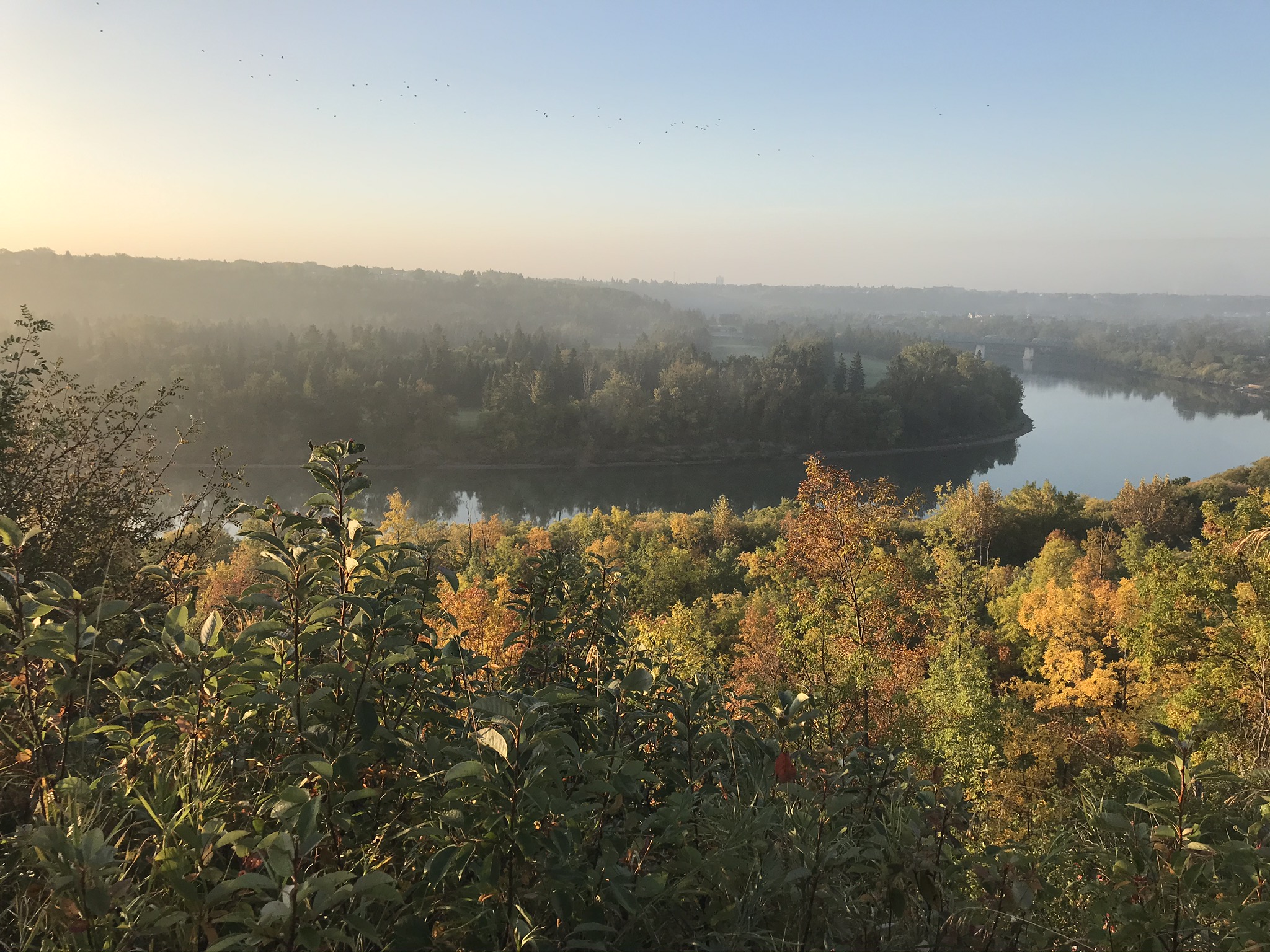
    A dense poplar forest… I’m imagining conversations now when I walk to the edge of the valley and look out on the dawn. The mix of cultures and languages and voices. The mix of species. How we could be together differently in this land.

    In gratitude.

  • Summer Solstice 2021: Waking Up

    The 14th century German mystic Meister Eckhart said that spirituality is waking up.

    On the brink of this Summer Solstice and National Indigenous Peoples Day, the longest day, this day of light, I want to acknowledge the sorrow of the families of the 215 children whose graves were found in Kelowna in May, and the generations of Indigenous families whose relatives were forced to go to residential school and never came home emotionally, spiritually or bodily.

    In 2006 when I worked with Alberta Alcohol and Drug Abuse Commission (AADAC), I travelled with an Indigenous colleague to visit some of our community partners in northern Alberta. I remember driving by the site of one of the residential schools and my co-worker telling me that during the demolition of the building, they had found the skeletons of infants. That was when I first knew there were skeletons in those schools.

    When the Truth and Reconciliation Commission (TRC) came to Edmonton in March 2014, I wasn’t sure at first if it was open to everyone, but I had a Cree friend who said, Yes, of course it was; she was going and I could go with her if I wanted. We spent the days sitting in packed rooms with the lights turned low. Those who spoke were seated in the centre circle, held by the wider circle, taking turns at the microphone. Always opening with prayer and smudging, then the stories, and the tears. We all cried. At the end of each session attendants gathered our used tissues at the doors in big paper bags to be burned outside in the sacred fire that was lit through the whole weekend. There were many revelations for me, but the biggest came at the end of the last day, with my friend’s family as we ate supper. I said how powerful the gathering had been for me, how glad I was that I had come, probably feeling a little pleased with myself too. One of the people at the table, agreed. It had been powerful. But in a quiet voice, she said she wished that there had been more non-Indigenous people there too. I looked around the room and felt ashamed. Reconciliation between parties can only happen if both sides are present and the truth is heard. That is when I realized that what Indigenous people want most from non-Indigenous people is to be listened to.

    In the past couple of years one of my writing projects has brought me into contact with more Indigenous writers, artists and community activists. In many ways the project has become secondary during this process, set aside. The most important thing to Indigenous people I am learning is the relationship: how to go forward “in a good way.” That and the need to listen also to the joy, the humour and the gifts Indigenous people hold for all of us. Or as one Cree artist challenged me to consider, “What about some cultural appreciation?”

    And so in these pandemic times I have been trying to seek out and follow Indigenous voices on social media, taking in Indigenous-non-Indigenous public dialogues, watching Indigenous documentaries and cooking shows! meeting regularly with a new Indigenous friend and collaborator on Zoom, reading and rereading Indigenous history and literature (some old, with new eyes; some new, from contemporary voices). I am still waking up, still learning.

    I see there are virtual celebrations over the next week in Treaty 6 territory. How will we celebrate National Indigenous Peoples Day?


  • Spring Equinox 2021: A doodle on the balance point

    This week my yoga teacher said, Think about your relationship with time… and what occurred to me in these COVID times is to wonder at our relationship with place, how relationships need to meet in real place as much as real time, something the online meeting has yet to master, because as humans everything we come to in this world is through the body: speaking, eating, seeing, hearing, breathing, moving, believing, knowing, but especially touching. This is presence. And how there’s a vague sense of displacement in all my relations right now, a sense of imbalance as we approach the balancing promise of Spring Equinox. And how excited, how heady, how giddy I become at the prospect and the reality of meeting someone, anyone in the flesh.

    Time keeps moving through space: water, wind, fire. It’s what defines life. Perhaps what it means to be human.  No matter if our land masses were separated by oceans millions of years ago, separated and reconstituted how many times? Birds, mammals, fish, humans: we keep migrating, we adapt. The earth recreates herself, hemisphere by hemisphere, season by season but especially in spring. Chooses to sprout, to root, to give birth to another round of life.

    There was a heart meditation I used to do with groups, “heart” for compassion, Buddhist in inspiration. Sometimes I would do it accompanied by a video from the National Film Board of Canada called Cosmic Zoom: Hold this moment in your heart: this body, breathing, alive, moving. In your mind begin to widen the circle of view, imagine yourself like a bird lifting from the ground, your home/your neighbourhood receding below, broadening wider and wider, the whole city/the whole countryside floating into view. See it in all its fullness: pain and expectation. Soon whole provinces, then countries, borders dissolving, rivers running into oceans. Holding more and more of it in your body. Continents slipping, becoming one green-blue-smoky whole, the lights of cities, the hum of rainforests. We move through time and back into space, Earth, one of a multiplicity of planets whirling, taking flight as we pass; moons in orbit; solar systems; stars and comets streaming by us. The galaxies we know and the galaxies we don’t know. Black holes and worm holes. The universe within us and around us, darkness and light.

    Until we stop to hold all of it, all of the displacement that precedes new growth: forests on fire in the Amazon, shrinking glaciers, and breaking icebergs. Oil patch labourers caught in the eye of climate change. Black Lives Matter protests, the small farmers protesting Big Agriculture in India, the democracy activists in Hong Kong, in Burma, the abandoned prisoners of war in the deserts of Syria, the memorials for missing and murdered Indigenous women, black women, women of colour and all women who die by violence. Seniors stuck inside long term care longing for connection, the frontline workers exhausted and the hospitality workers waiting for the end of COVID. People lining up for vaccinations. Tulips and perennials pushing up from the soil in our own backyards. Migratory birds getting ready to sluff off their southern wintering grounds and the child refugees of Central America massing on the southern US border. We hold all of it in this body. This heart. And then we let it all go. As so many struggles surge forward to come into the light.


  • Winter Solstice 2020: A Deepening

    Growing up I was afraid of the dark. I was afraid of going to bed at night. I was afraid of going down into the corners of the basement in the middle of the day, where I would often get sent to fetch things. Mostly I was afraid of the unknown. What I might find there.

    I have come and left, come and left in my Edmonton neighbourhood three times in the past 30 odd years. The first two stays were short: a summer break spent in a heritage home near 97th Street, a year and a half near 95th Street in an Italian bungalow built like a bunker, and more recently 8 plus years off 92 Street, east of the LRT tracks.

    When I first started living here those many years ago, I had an imaginary security system in my head. Day or evening, it didn’t matter, I had an elaborate map of homes of friends and acquaintances on each block, and I would time evening walks and trips to the grocery store to coincide with some of these locations. If something should happen to me down this block, I reasoned, I could knock on this or that person’s door and someone would let me in. I never had to use it in all the years I’ve lived here.

    Something changed in the decades of my coming and going in the neighbourhood. This section of town still has a high transient population and a high crime rate, but somewhere within, something changed in me. I kept being drawn back by the differentness, by the diversity. The Other no longer seems other or perhaps I recognize the other in me too. When I go for walks in the neighbourhood now, I don’t scout out the safe doors. I go without expectation of any kind. This doesn’t mean I live without fear. But I’m getting better at accepting my fears, at accepting the risks of living. This is a metaphor for how I feel in the world now, venturing further and further each day, and feeling at home in it. I imagine someday I will feel so at home, it will be time to go.

    Loss comes to us sharply at this time of year and this time in human history. This pandemic has demanded a deepening, a going inside the self, with nowhere to hide, no defenses, or distractions but unadulterated reality. This is the reckoning. What is important? What feeds my soul? What starves it?

    Night is not without light or colour: Planets. Stars. Galaxies. The moon in all her phases. For those of us in the higher latitudes, the northern lights.  What if darkness and light are not necessarily opposites, but mirrors of each other, real by contrast, fundamentally connected?

    Some limits we grow through. Some are temporary and we learn to weather them. Some spur creativity and innovation. Then there are losses which are irretrievable. The loss of a child, a loved one. A people. A language. Species loss.

    Perhaps this season is most about Mystery. The reality of death and the continuance of life and the dance between them. Because there is space, story can enter in. Memories of people and place. Imaginings of what could be.


  • Fall Equinox 2020: The Birds Are Sentinels

    Where I usually walk: along the North Saskatchewan River with smoke from the West Coast wildfires (Sept 17, 2020).

    The last couple of days walking by the river, I’ve run across a flock of robins, country robins, judging from the way they spook on seeing me. Maybe they’ll be there tomorrow; maybe they’ll be gone. It’s one of their migration strategies, to stop and refuel every so often. Most migrating birds fly at night. Birds have a compass of sorts in their eyes. They take bearings from the stars, the moon, the setting sun and the land itself. They can actually see the Earth’s magnetic field. They often fly north and fly south on different flyways, routes that arc to follow food sources. These robins may fly to the mid-States, or the Gulf coast, or as far as southwestern Mexico before they’re done.

    Equinox anywhere in the world, is migration. Compelled by a mysterious memory, an ancient faded connection to a lost half of planet home. Most bird species will go in waves, first males, then adult females, and then the young, who somehow find their way to the same location as their parents without ever having seen it before. Scientists call it, “site fidelity.” There are always obstacles: skyscrapers, storms, fires. There is always death, but this year is different.

    Birds are a sentinel species. Harbingers. Sensitives some might say. The literal canaries in the coal mine.

    As the smoke wafted north to my home province of Alberta this past week and human tragedy unfolded along with the west coast wildfires,  the birds may be telling of an even greater tragedy on the horizon: catastrophic climate change. This year, migrating birds are dying in “unprecedented” numbers, perhaps hundreds of thousands. Reports started coming out in the middle of August from Arizona, New Mexico, Colorado, Texas, and four northern states of Mexico. Small birds, songbirds: western bluebirds, swallows, flycatchers, warblers, sparrows. Starving some said, no fat reserves left. Acting odd, dying in the open. Dozy. Disoriented. Falling out of the skies; many of their faces dented as if they had flown right into the ground. No one knows for sure the cause yet or if there is any one cause (drought, freak snowstorms in New Mexico, wildfires all down the west coast, habitat loss, delicate lungs) but so far most of it points to one common root: climate change.

    Scientists say some birds have already started to adapt to climate change, shifting their nesting grounds further north and beginning to migrate earlier than 30 years ago. There’s also fewer of them: some scientists say we’ve lost three billion birds since the 1970s. There’s a place for fire in the ecosystem: habitat that’s recovering from a burn is at its peak for diversity, flora and fauna. Burned habitat can lead to a greater diversity in the very “language” (the calls, the songs) of some bird species. But can this diversity be sustained through successive, back-to-back fire events? Scientists think some birds are inextricably tied to a particular place. Once it’s gone, can they ever return?

    Birds are harbingers. Humans and birds are among the few species that can make song.

    When Rachel Carson wrote Silent Spring in 1962 about the environmental fallout of DDT and other pesticides, it was the stories of dead birds and the thought of a planet without bird song that compelled her. After Carson’s book and the legislative and regulatory changes that were made, many bird populations did start to recover. And humans were better off for it.

    Birds are sensitives. During this time of COVID, when I’ve had to slow down, travel closer, consume less and contemplate more, it’s harder to avoid the questions: What would the world be without a place to nest? To hunker down? To call home? And what would Equinox be without migrating birds?

  • Summer Solstice 2020: The Fullness

    COVID-19. One word with so many contradictions: death, innovation, anger, selflessness, anxiety, adaptation, depression, creativity. The fullness of life! To date, at least 8,457,305 infections; 453,882 deaths. We hear the counts every night like reports from a war zone. We know it is not gone. The financial fall-out we haven’t begun to comprehend. The isolation affects all of us differently. For me the last few months have been like living in slower motion.

    Focus sharpens in times of illness. We come face to face with mortality. We have time to think. We see and hear in ways we haven’t before. This slowed down time, this slower motion has revealed itself to me like a kaleidoscope, the changes going on around us and within us. We see the turn of the seasons close up. A birds-eye view, this time of concentrated inward reflection in the world. This time of intentional watching has revealed the contrasts and contradictions: Black and Indigenous lives matter! People can work at home and be productive. Children and parents have more time to bond. Those already isolated find they have more ways of accessing the world online. We can cut greenhouse gas emissions, just like that.

    We have to be still. We have to listen. We have to be.

    I offer three strategies for COVID, think of them as spiritual practices. From my own experience: Walk. Walk more. Give thanks.

    Walk or whatever movement you can manage. I had a sprained ankle for the past six weeks, so sometimes that movement has been guarded, sometimes limited to watching the movement of light, wind, and life outside my window.

    In the river valley, I’ve found my way around paths I was afraid to follow before. The Dawson-Kinnaird parks are riddled with animal and human trails in hidey-hole places. I’ve taken them, daily, sometimes twice daily, and learned their routes as I’ve followed my feet. When there was still snow on the ground and long before the leaves, I followed the trails, winter into spring, spring into summer, knowing them one layer at a time, when I knew I couldn’t get lost. And now I can’t. (For the full unfurling I’ve witnessed this spring, visit my twitter feed @audreyjwhitson)

    Walk more. Make a pilgrimage where you live, another practice I’ve taken up. A pilgrimage in honour of Saint Brighid suggested by a friend of mine in the neighbourhood with Irish heritage, Kate Quinn. I set out on this walk at least once a week early in the morning. During COVID, the streets are quiet. I see the occasional fellow drinking coffee on their deck, smoking a cigarette, searching for bottles in the dumpster or walking like me. Everyone is friendly. I don’t remember a time when I felt so comfortable talking to “the stranger.” We know we’re all in this “unprecedented” time together. I stop at the homes of neighbours I know and pray a blessing over the hedge, “May the cloak of Brighid flow over this house.” Occasionally they see me or I see them through the window, but that is not the point. The point is to be present in the void. The point is to ground myself in my world and to come home feeling more connected than when I left.

    Give thanks. The final strategy for COVID is something I’ve learned from another friend in the neighbourhood and have adopted as my own. I’ve kept gratitude journals over the years and prayed lists too. But this is simpler and means more to me. At the end of every day I write down one thing that has made the day extraordinary: some encounter, some event, some exchange. For me that might mean crossing paths with wildlife; experiencing a piece of art in word, image, or sound; a rich conversation with a friend or receiving a comment from a complete stranger. Often something small in the scheme of things.

    Savour the fullness in the nothingness of this time.

  • Spring Equinox 2020: Pregnant with Possibility

    I did not go to Spain this spring. It wasn’t easy to make the decision; I left it till the 11th hour. The Canadian Government (as with most governments) was still giving a Level 1 travel advisory for most of Europe: “Travel and take precautions.” It wasn’t until the WHO declared COVID-19 a pandemic, the infections in Spain doubled in a day, and work told me I would have to self-isolate when I returned, that I saw the writing on the wall. Sometimes it’s a battle to see the trends. Sometimes we don’t want to believe what seems an extreme outcome. This spring equinox a microscopic virus has halted all our best laid plans: our RSPs, our jobs, our studies, all our strategies for economic growth, and our travels. All we want is to go back to “normal.”

    There’s another crisis we are facing in the world right now: climate change. Something we’ve known about since the 1970s but have had a harder time coming to terms with. Something there will be no simple vaccine for. Some scientists call our age the Anthropocene for the huge impact humans have had on planet Earth. A friend, referring to COVID 19, said to me, “Maybe this is how it happens, the death of the carbon economy. With the drop in oil prices and the rise of the tech sector, the rise of the new economy.” Though not without cost.

    It’s worth remembering the roots of the word “economy” come from the Greek meaning home or household and meaning to manage. What does it mean to manage our household and our home, the Earth? Maybe this is the meteor of our epoch. Maybe we have an opportunity in this moment of solitude, of renewed family ties and friendships, cyber work and learning environs, to birth something radically new.

    In Alberta, where I live, spring is like a battle every year: a see-saw between temperature and precipitation. One day it snows, the next it melts. Back and forth, a tug-a-war; the coming of spring can take months. It’s a limbo time, a liminal, in-between time, pregnant with possibility. Change may have many false starts and then seemingly, miraculously, come like an avalanche all at once. Every spring in many ways, a whole new world.

    The day after my decision to postpone my trip, a friend said to me, “Barcelona will still be there next year.” It will and so will we, together.  Another friend forwarded me a note she’d had from a friend of a friend (the wondrous side of social media) quarantined in Barcelona. The contact described the sound, around 8 o’clock in the evening, coming from the street on the first day of the lockdown. Something loud and popping, something exploding and boistrous like the sound of firecrackers. But it wasn’t firecrackers. It was the sound of citizens, everyone out on their balconies, thousands, perhaps hundreds of thousands; everyone clapping for many minutes. Clapping, the neighbours said, for frontline healthcare workers as they battle COVID 19.

    We need to stand together. We need to applaud the heroes on the frontlines of COVID 19 and on the frontlines of the climate crisis. We will survive and we can birth something new, together.

  • The Breath of Winter: Solstice Eve 2018

    Many years ago now, around this time of year, I came down with a bad case of bronchitis. My lungs were not the same afterwards. I was diagnosed with asthma. About 10 years ago, I started having more and more reactions to the medications. In 2009 I went for acupuncture. More than a year into treatment with Dr. Aung, on the first smoky day of the wildfire season, after standing outside for 20 minutes for a work function, I realized that I wasn’t wheezing like I normally would, I wasn’t having trouble breathing at all. I went for all the tests. There was no sign of the asthma. I threw away my inhalers. 

    Fast forward to November 2018. I caught a virus in mid-November, a bad cold that went to my chest and sat there, the way I used to feel when I had asthma. I would have to catch my breath while talking. I would sleep for 10 hours and feel in the morning as if I had slept for five. This went on for weeks. I couldn’t figure out why after so many years, it felt like the asthma had returned. “You just need rest and time,” the doctor kept saying. “Rest and time.”

    The very first time I saw Dr. Aung, there was still ice underfoot, but spring was on the air. I came out of the clinic afterwards, my whole body vibrating, shot through with bits of air and light. The street was awash with the drab pastels of that season, an amalgam of sensations and shapes: office towers angled overhead, the sky clouded, the bare trees and my scarf bending with the wind, the feel of a cracked sidewalk under my feet, all of it lifting me, threatening to carry me in its current. For the whole two blocks to my bus stop, cars were coming and going on the street, all around me people were passing, their voices hushed, but I felt connected to each one, reverent, the feeling of their day close to mine—excited, happy, sad, fearful—a swirl—everything speeding as we passed each other. It was like looking at the world through a kaleidoscope.

    When I went looking for that experience this week, the place where my journal fell open was about two months into my treatment. It was the record of a conversation with Dr. Aung.

    “Can I give you a hug?” he asked me.

    I took his hug and I said to him, “I don’t know why, but my asthma is really bad this week.”

    “Sometimes sadness does that to us.”

    “You’re right! That’s what it is!”

    I can tell by looking at you; I can see.”

    Sometimes it takes us a while to see what’s changed inside. There has been some sadness in my life of late. Losses, not with the permanence of death, but losses still, of trust, of surety, of innocence. Midwinter can be a difficult time. It’s why we gather our families and friends around us, why we feast and sing and tell stories of hope. Without sadness we wouldn’t have joy. Without darkness, light.

    I went twice to Dr. Aung this week for acupuncture and cupping. Both work on the theory of qi or ch’i, variously translated as the dynamic life force or flow of energy. It’s a concept not unlike the Hebrew concept of ruach, which means wind, breath, and spirit. To breathe is to live; to breathe is to pray. Both are true. The practice of qi gong is the practice of balancing energy. Blockages stop the flow. Our breath is what connects us to everything.

    Within hours of the first visit this week, my lungs had calmed. I slept the deepest sleep I had in a month. I’m recovering my breath and with it my spirits.

  • Fall Equinox 2018: The Stillpoint

    I walk to work every day, zig-zagging, cross-stepping as-the-crow-flies, in a beeline from my place in Boyle Street, on through downtown Edmonton. This year some of the route has changed as my own life has changed. Work has moved and my role with it; I have to walk a little farther than I used to. But there are stillpoints along the way. Vistas, soundscapes, and living creatures. Some are predictable, some surprise and then disappear. Those last I call angels. Stillpoints, all, because they stop me in my tracks, because they bring me out of my head and into the present moment.

    One of my favourites is a window at the corner of 105A Avenue and 93 Street, a window that beckons in early morning, spring, summer, fall or winter. A window whose season never ends flanked by a red steel door and a Manitoba Maple probably as old as the neighbourhood, thick at the trunk and gnarled; the leaves this time of year moving slowly from green to gold. The beckoning window looks east and is filled with plants: a spider plants, a prayer plant, plants I don’t even know the names of. Behind the window sits a filing cabinet, a book shelf, and a desk topped with piles of paper. In the next cavernous room, behind other windows and under high ceilings, men stand at work benches, hunched over machines. The green window follows me down the block, caught in my mind in a maze of brick and steel and grease.

    Many times in the six years I’ve walked the route, I’ve wondered who tends the plants. I’ve speculated. A woman obviously. I’m not sure why I would be so confident of that. A woman with her own office. A woman among a sea of men. The bookkeeper? Human Resources? The site nurse? A manager? I had never laid eyes on her. Until this week.

    Friday morning she was there, framed, red-haired, in the window, smiling, watering her green plants as outside the snow fell lightly to the ground. Thank you, I wanted to say, in a world so out of balance with time and with the material, a world filled with violence masquerading as truth, for continuing to pay attention to some of the simplest, the most real, processes of being.

  • Spring Equinox 2018: Here for good

    Recently someone new to Alberta asked me, “When does the snow stop?” really meaning to ask, “When does spring come?”

    “It comes and it goes,” I replied. “And then suddenly it’s here for good.”

    My mom left a message on my phone a couple of weeks ago: “It’s running out there! You can hear the water. It’s running down the drains. It won’t be long now. Just a few more warm days.”

    The seesaw of melt and ice.

    Spring, like all seasons, is a transition state. Spring reminds us that there is growth in every season of our lives. Like all transition states, beginnings require careful navigation. It’s slippery. We’re not always sure of our footing.

    Early in February I celebrated Brighid’s Day, what’s sometimes called the Celtic spring, with about 20 other women. We took turns passing through Brighid’s crios. Brighid’s girdle was once a hoop made from the old year’s harvest straw; our girdle was made of strips of cloth found at Fabricland. Three times we passed through the crios. Circling left and then right and then left again and through. First to leave behind all that was ill, then to give thanks for all gifts of the year past and then to pray for new growth.

    We entered the womb of Brighid to be reborn.

    This spring I am conscious of new relationships emerging, not only in my personal life but in my community. I’m not always sure of my voice in these relationships and often feel as if I am taking two steps forward and one step back.

    In a close personal relationship I am exploring, there is a testing in the dialogue as we come to know each other’s edges and strengths, as we talk about what is really important to each of us, as we come to see our own vulnerabilities in the mirror of the relationship.

    In the same way, I’ve been witness this past year to an emerging dialogue in Canada between Indigenous and non-Indigenous peoples, at work, in public gatherings, in the media and amongst friends. For me, the talking and the listening is cause for hope.

    So it was serendipitous this past February that I got to visit New Zealand with this person I am exploring a partnership with, a Pakeha, a person of European or non-Maori ancestry, who grew up there. That I had the opportunity to witness a different sort of relationship between settlers and Indigenous peoples than one I am used to, a partnership grounded in mutual respect.

    Maoris were granted the same rights and duties as a British citizen with the Treaty of Waitangi (1840) as well as control of traditional lands. Like Canada, the treaty wasn’t always observed. Rights were trampled. Lands taken. Residential schools were imposed. The social effects of this are still evident to some extent. But the Maori have always been represented in parliament; the Maori have always had the vote. Their land claims process has largely been a fruitful one. They communally administer their lands; they also individually own sheep stations and tourist resorts, live on “lifestyle blocks” (acreages), and in villages and cities where they work alongside everyone else. Most of the towns have Maori names and many of the streets. This is a country whose educational curriculum is written in two official languages and incorporates not only Western content, but Maori principles. The consciousness is different.

    Like an Alberta spring, justice may come and go, but I do believe one of these days it will be here for good. If we keep at the dialogue.

  • The Hope of Spring 2017

    Coming home on the bus in the middle of February, deep in the last cold snap of winter, I sat beside an elderly woman who swore she could smell the Athabasca Glacier, all the way from the Columbia Icefields. She could smell it on the west wind, that very day. She had been there once. She knew.

    “What does it smell like?” I asked, curious and more than a little skeptical. “Like rotting garbage?” (Thinking of all that debris.)

    “Oh no,” she said, “so fresh! Think of the water molecules released that haven’t been breathed in ten thousand years! The pure air, just lying there, never touched!”

    When I got off the bus that night, I admit, I tried to sniff the air a little against the minus twenty-nine degree wind. It didn’t last long. I pulled down my hat and covered my face with my scarf and bee-lined it for my apartment and my fireplace.

    But I haven’t stopped thinking about her words. They touched something in me: the dream of life stacked layer upon layer. The layers of story under our feet. The generations that have gone before us, their genes and their experiences, my own life experiences. Some of them like an ice sheet, some like an Arctic or a Pacific Ocean. Some like a volcano or an earthquake. How they’ve all shaped who I am today. The parts buried and exposed; the parts that still await discovery.

    The change of seasons reminds me of that promise, spring perhaps more than any other. Every spring is a piece of the spring gone before and a piece yet to come. The layers speak of a new generation. The freshness in the air, something not thought of or felt in months or years. The earth remembers itself, unfurls ancient molecules—soil, air, water–seed. Hope.

    Saturday night in the Quarters near where I live, the community gathered for Glow, a lantern parade on the Armature to welcome spring. The theme was Under a Prehistoric Sea. The land of what we now call Alberta was, more than once, covered by oceans. The bobbing lanterns in the crowd attested to that: jelly fish, star fish, giant turtles, prehistoric sturgeon. And there was a strong wind blowing, cold, just possibly, I thought afterwards, off a glacier.

  • Fall Equinox 2016

    Enjoy the trees blowing in the wind while reading a book on the couch, my favorite thing.

    Those were the parting words of the owner who last lived in my condo. I too enjoy the sound of the leaves in the wind. I notice them more in the fall, maybe because the leaves are crisper or maybe because there’s more wind. I’ve set my reading couch to look right out the window of my writing room, right into the eye of the trees. Our courtyard is full of them. As I write this, I’m listening.

    Summers I like to read: classical literature or philosophy; I alternate. This summer I read Heraclitus, a kind of Ecclesiastes of the fifth century Greek world, a philosopher, literally a “lover of wisdom,” but a century or two ahead of Socrates, Plato and Ecclesiastes. Scholars credit Heraclitus with the notion of Logos (or Word) in Western thought.

    By cosmic rule,
    as day yields night,
    so winter summer,
    war peace, plenty famine.
    All things change.

    Fragments+ is a thin book really, called that because all we have left of Heraclitus are other people’s quotes of his writings. As a book it’s more poetry than prose, more contemporary than ancient, or perhaps it is the times we are living through that are ancient.

    But Heraclitus is not done with us. There’s something else to this fragment, one of the longer ones we have received from him. He makes reference to the closeness of death; close, too, during this season:

    Fire penetrates the lump
    of myrrh, until the joining
    bodies die and rise again
    in smoke called incense.

    I recall one of my professors once saying that you could translate the opening words to the Gospel of John, “In the beginning was the Verb” instead of “the Word.” Logos is a motion, a process, all of it energy, what Heraclitus named fire. “All things change.” Somehow in the change is the Mystery.

    +Heraclitus, Fragments, translated by Brooks Haxton, Penguin Books: Toronto.

  • Midsummer’s Eve 2016

    DSCN5504

    On my route along 92nd street, past the Mother Teresa School, under the elm clad arches of 104th Avenue, along the wild gardens of Boyle Street plaza, the sunken hidden garden by the courthouse, through the piazza fronting city hall. Past the robin’s urgent mating yodel, the see-sawed whistle of the house finch, the white-throated sparrow’s O Canada Canada Canada, the chickadees Summer’s coming summer’s coming, the yellow warblers sweet sweet shredded wheat. Past all these, the calls, the hurry, the frenzy of spring have calmed to a steady hum, a conversation of clicks and clacks, of clucks, murmurs, or a simple chirp. Even the humans have quieted, the traffic thinned in the downtown core. This is the conversation of summer.

    Lately I’ve been purposely stopping to listen to the quiet, to feel the warmth of the wind in my hair, to look at the wild roses blooming in the city on my way to work. (Have you noticed how pink the blossoms are when they first come out?) I go into the office buoyed by these small glimpses of joy, more generous-hearted, more at peace with whatever the day might throw me. I try in small ways to keep stopping and feeling. To look up from my computer screen and out my window for twenty seconds at a time. (Because it’s good for your eyes too.) But it’s hard to look at one thing for twenty seconds without wanting to fill the mind with some thought, something I must remember, some sentence I should write down, some phone call I should make. And when I get home, it’s sometimes hard to sit on my lovely new patio and simply look at the green, green courtyard and hear the wind in the poplars without reading or writing or rushing off to my next commitment. It’s sometimes hard to just be in my breath and breathe and breathe until the enough becomes clear. Yet, I’m convinced this is how the well of love is fed and so I keep trying and will keep trying to practice this open-heartedness to beauty that opens up my life.

    About a week ago the daughter of an old friend of mine died of cancer. Joanna was 33 years old, smart, passionate, and full of life. A small tumour on her tongue eventually took over her body. From diagnosis to death was less than a year. She was just coming into the summer of her life, but in many ways it seems she was wise beyond her years. After the celebration of her passing on Saturday, I came away with this: the challenge is love. For Joanna that meant a constant curiosity about the world around her and the world inside her. She was always listening.

  • If I were a writer in Cuba

    I often pondered this question when I was in Cuba. While there, I was able to attend the 24th International Festival of the Book in Havana, one of the largest book festivals in Latin America, founded in 1982. For ten days, the city diverts buses from their regular commuter routes to transport thousands of Haberneros to the festival site at the medieval La Cabaña fortress across the bay from central Havana. Launches are held all over Havana at cultural centres, libraries, and bookstores. (Cuba boasts more than 500 bookstores and I kept seeing them all over Havana.) Families flock to La Cabaña on weekends; school children attend readings during the day in all parts of the city as part of the curriculum. Publishers come from all over the Spanish-speaking world. After Havana, the festival goes on the road, with stops in every major city in the country. Many Cubans buy their books for the whole year at the festival.

    At this year’s festival 850 new works in social science and literature were launched, and two million copies were sold. I can attest to the people who carried armloads of books up to the till for purchase and the long lines formed throughout the festival site. For a city of 2.2 million people, that’s an astonishing number of readers. Ah, I thought my day at the festival, if I were an writer in Cuba, I would have an adoring public.

    Visual artists occupy a similar status. Havana boasts 22 galleries and at least 11 theatres. I visited several studios and workshops of painters, sketchers, and silkscreen masters. Their work seems fresh and inspired, and perhaps because of the political situation, they seem to have mastered the genre of the abstract. Theatre seems to occupy a similar status. I had the opportunity of attending a showing of Rent, the first full Broadway musical in Cuba in more than 50 years. It was a stunning show, on par and as professional a production as I’ve seen anywhere, including New York. I was reminded of a Chilean friend’s comment to me thirty years ago, when I visited his country and expressed naive surprise at the high education levels of the population, the presence of so much quality literature and music: “We are an economically underdeveloped country, not a socially underdeveloped one.”

    But there is another side to this, both practical and political. Books published in Cuba are worth about 10 to 20 pesos in moneda nacional; that’s between 50 cents and one Canadian dollar. A folklorist I met my first day in Cuba told me that a Cuban publisher had asked her to write a book on traditional folk songs, but she would be lucky to make a peso a book on the project. She declined. Her clothes, while stylish and carefully matched for colour, were torn along the seams in places, buttons missing, and were likely third or fourth hand. She works as an arts administrator in the city. I couldn’t help but think of our arts administrators too, with low pay and long hours.

    Writers and writing have been tightly controlled in Cuba. As recently as last summer, Cuban poet Rafael Alcides Perez, considered one of Latin America’s most renowned living poets, publically resigned his membership in UNEAC, the government-sanctioned writers and artists association in Cuba, because his books (published abroad) were not allowed into the country. An early member of UNEAC, in recent years he has been vocal about the country’s issues. While I was at the festival, I heard the Cuban American, Uva de Aragón, read from her novel about the experience of Cuban-American exiles in Miami. While she was allowed to attend the festival, she wasn’t allowed to sell or leave her books behind.

    Media outlets are government monitored and controlled. This becomes evident when you watch the 8 o’clock national news as I tried to most nights. While there are interesting stories from other parts of Latin America that often don’t make our newscasts in the northern hemisphere, much of what is reported on internally is news of the Party more than a debate of the issues. This pattern transfers to the internet too. Very few Cubans can afford or are allowed access to the Web. You will find cable television with CNN and internet access in many high end hotels, and you might be allowed unfettered access to the Web for research purposes if you are an academic, but the general population cannot dream of this privilege.

    Finally, La Cabaña itself, in the early days of the Revolution was the site of a notorious political prison. Most of those held here were former members of the brutal Batista regime, but not all. There were many, perhaps hundreds, of executions without trial. One might say that this was understandable, given the history and the war. But Cuba has had its own concentration camps, the Isle of Pines, for example, where stories of prisoner abuse were on par with those of Russian gulags. With 57,000 inmates (by 2012 numbers), Cuba has one of the highest prison populations in the world. There are those in for the standard crimes: drugs, murder, theft. There are those who are arrested for having no job and keeping bad company, what the system calls “pre-criminal dangerousness.” Finally there is a third category, political prisoners, less than in previous years now that they can choose exile, but according to Human Rights Watch, at least “dozens.” Dissidents, bloggers and journalists among them, are still harassed, either through public shaming, the termination of employment or arbitrary arrests without trial. I encountered a small hint of this while I was in Cuba. My folklorist friend told me in a lowered voice that she was invited to join and even publish with a group of dissident writers in the city, but where would that leave her? she asked, hinting there would be consequences she and her family could not afford. I wondered what I would do in similar circumstances.

    It was these whispered conversations, though, the fact that they are taking place at all, that gave me hope for change. While in Cuba, I often found my travel to a destination and not the destination itself the most revealing. I had conversations with other writers, teachers, painters, musicians, taxi drivers, people I met on the bus and in the street along the way, that gave me the sense that Cubans on every side of the debate about US-Cuban relations are holding their breath, wanting to believe but waiting to see if their future will be different.

    I left with the sense that this moment in Cuba is a beautiful and fragile one, that social development has continued in spite of political repression, and its urgency made only more acute by being drawn against the canvas of a vibrant cultural life. Oh, that artists could play as important a role in the social fabric of my own country!

    As I shouted out !Bravo! with the rest of the audience the night I saw Rent, I want to shout out !Bravo! to all who write, paint, act, sing and speak. Sigue marchando adelante. Continue marching forward.

  • Brighid’s Wheel: The Perpetual Fire

    This past Wednesday I saw my doctor for my annual physical. Last year at this time my blood pressure was 80/60. I had been feeling the fatigue for months and would for many more. This January my blood pressure was back to 104/72, normal for me. I had always had low blood pressure, but never so low. Was it the long hours involved in publishing my second book? Was it stress at work? Was it diet?

    I tried salt. I limited my intake of carbohydrates. I initiated a 360-degree feedback process for self-awareness. A few months ago my energy started to shift; this past week I was even up early some mornings at my desk writing again. Friday I walked to work with the light beginning to break on the horizon. The first time in months. And I remembered that we are at the Celtic spring, the feast of Imbolc and the return of the light.

    I am put in mind of the perpetual fire at Kildare, Church of the Oak, a sanctuary pre-Christian in its origins, tended by a group of nineteen holy women, each taking a turn holding vigil over the fire for one day, then on the twentieth day leaving it for Brighid to tend herself. Though the fire consumed fuel, it was said to leave no ash.

    There were vestal virgins in Greek and Roman times as well. But historic chroniclers tells us that the fire at Kildare was still burning in the twelfth century and probably not extinguished completely until the British suppression of the monasteries in Ireland, during the sixteenth century. The fire was re-lit in Kildare in 1993, where it is tended once again by a group of women dedicated to Brighid.

    The number nineteen is significant astronomically. Babylonian, Hebrew and ancient Chinese calendars were based on a nineteen-year cycle worked out by astronomers to synchronize the number of times the moon orbits around the earth and the earth around the sun. Nineteen is also a common eclipse cycle for the sun and moon. Some standing stone circles in the Western Isles of Scotland were built with a nineteen-year cycle in mind; at Torhouse the circle is comprised of nineteen standing stones.

    Brighid’s wheel is a sun symbol and Brighid herself was a sun Goddess before she became a Christian saint. The women at Kildare were feeding the fire but more than the sun’s fire, they were feeding their souls, keeping vigil over the light within. The perpetual fire is the human spirit, the light that is never extinguished, even though we may see no evidence for its existence for long stretches, only ruins where it once shone. Sometimes it moulders unseen in our hearts, sometimes there are only coals, sometimes only memories.

    William Blake wrote:

    The Human Dress, is forged Iron
    The Human Form, a fiery Forge.
    The Human Face, a Furnace seal’d
    The Human Heart, its hungry Gorge.

    And sometimes others tend the fire for us.


  • Letter from Sage Hill

    Well, from the Sage Hill Writing Experience actually. As Philip Adams, the Executive Director, likes to joke, the name sounds like something cooked up by a bunch of hippies sitting around a circle smoking their favourite leaf. And may have been, but it is an experience. First there’s the people: the writers who come here from all over Canada for ten days to learn, to teach, and to read from work in progress. A meeting of the tribes, and some of the best writers in the business. Then there’s the landscape: the painterly Qu’appelle Valley near Lumsden in Southern Saskatchewan, the way the colours of the prairie hills change with the time of day and with the light, the way the barn swallows dive and dance the thunderstorms, the early and late airs. So many birds: meadowlarks, blackbirds, robins, catbirds, kingbirds, Baltimore orioles, so many singing sparrows. There’s the physical building itself, an interchurch retreat centre with a Franciscan legacy. The round chapel in the centre that’s a cool refuge from the heat of the day. The Franciscan Friars who do the dishes morning, noon and night. The bedrooms so narrow that one has to go outside to turn around. And I must mention the food, which reminds me in a good way of the best of farm kitchen cooking from my own childhood, especially the desserts, only Saskatchewan is a different country.  Nowhere else have I eaten exotic Half-Hour Cake or Pudding Cake or seen Matrimonial Cake (called Date Squares in Alberta) served with a spoon, and rice pudding baked in an oven. And yes, the coconut creme pie (think truck stop) is to die for.

    Now i’ll wait for the Saskatchewan ex-pats to correct me.

  • When the Rain Stops Falling

    Last weekend I went to see When the Rain Stops Falling, a play by an Australian, Andrew Bovell. It was mounted by the U of A Studio Theatre, whose productions I have always found daring and top-notch.

    One of the opening scenes sent a shiver through me.  The year is 2039. It’s the middle of a storm, by the sea, and a man walks alone. A fish comes flying out of the sky. The man doesn’t know where it has come from, whether an answer to prayer or a freak of nature. He is pondering what to feed a son whom he’s never met, who is coming for lunch. Fish are nearly extinct, only the rich in the most exclusive  restaurants can afford them.

    This play is about our logical future: the rain that will not stop; the fish that are extinct. This is where we are heading. I know that. But has anyone said it out loud in such an intimate way to me before? The many ways our connection to living things has been lost?

    Ironically, or perhaps purposefully, this play is also about our lack of intimacy with each other: how a secret can distort a family through four generations, and the shame lived in silence.  They are in every family tree: the things that keep us apart, the cost of that isolation. The need to know, the search that unfolds, the questions. The memories, no matter how partial, that can guide us if we acknowledge them.

    By the end, when it does stop raining, there’s only the glimmer of a lost memory, of connection, enough though to hope. And the proof, more than a week later, is that I’m still thinking about When the Rain Stops Falling.